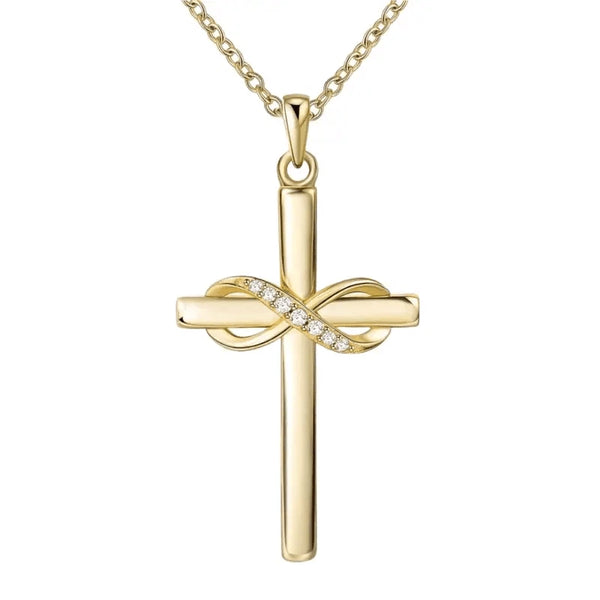
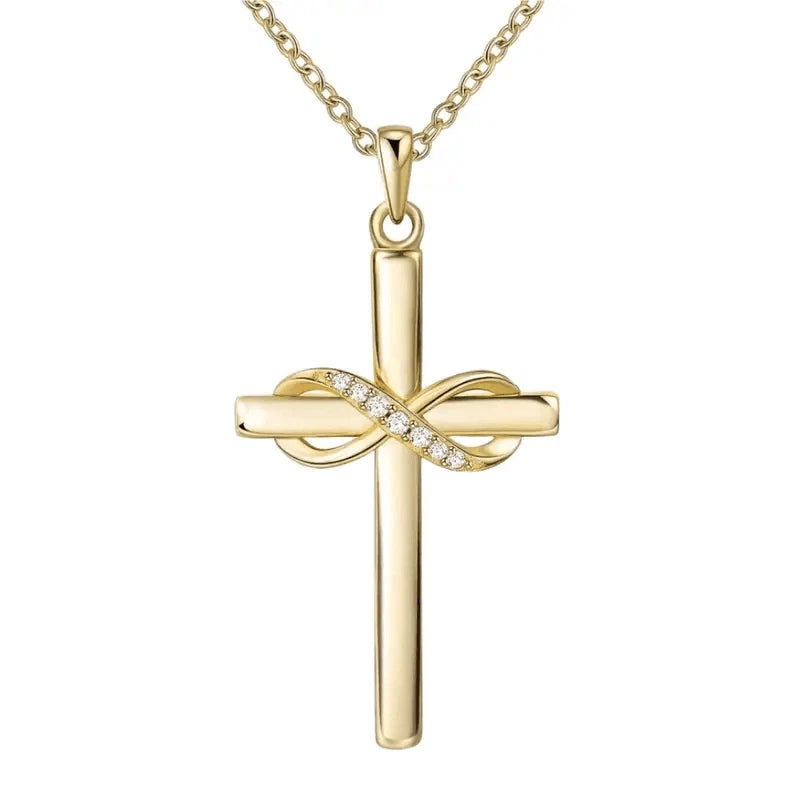
An infinity cross necklace pairs the Christian cross with the sideways figure-eight infinity symbol, so the pendant carries two separate ideas at once instead of one: the cross's message about faith, and the infinity loop's message about something that never runs out. Put together, the two shapes are most often read as “faith that doesn't expire” or “a love, a promise, or a bond meant to last” which reading fits best usually comes down to who is wearing it and why they picked it.
Quick Answer
An infinity cross necklace pairs a Christian cross with a sideways figure-eight infinity symbol, layering two independent meanings into one pendant instead of one: the cross's claim about faith and the infinity loop's claim about something that never runs out. The infinity shape itself carries no religious history on its own it began as a seventeenth-century mathematical notation for an unlimited quantity so any spiritual weight it carries here comes entirely from being set against the cross, not from the loop by itself. Combined, the two shapes are most commonly read as faith that doesn't expire, or a love, bond, or promise meant to outlast a single moment, which is why the design turns up equally in confirmation gifts, anniversary gifts, and remembrance pieces for someone no longer present. For a pendant meant to say something about how long a belief or a bond is expected to hold, rather than just naming it, that combination a recognizable faith symbol plus an unmistakable “no end point” symbol is the entire case for wearing a cross with the loop worked into it rather than a plain cross alone.
What Is an Infinity Cross Necklace?
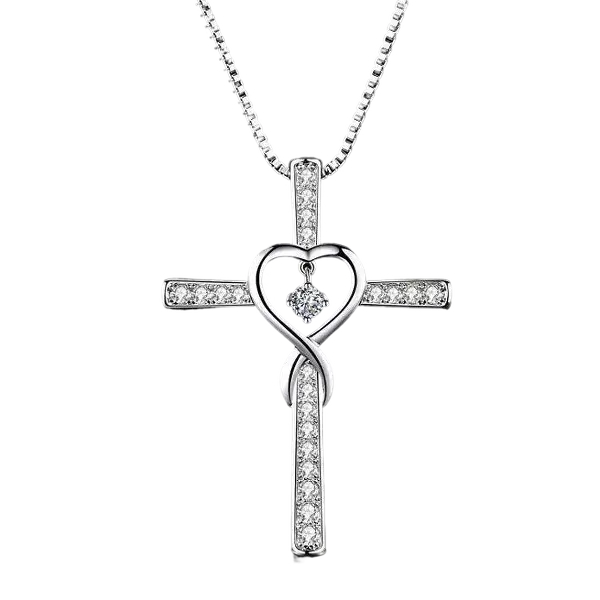
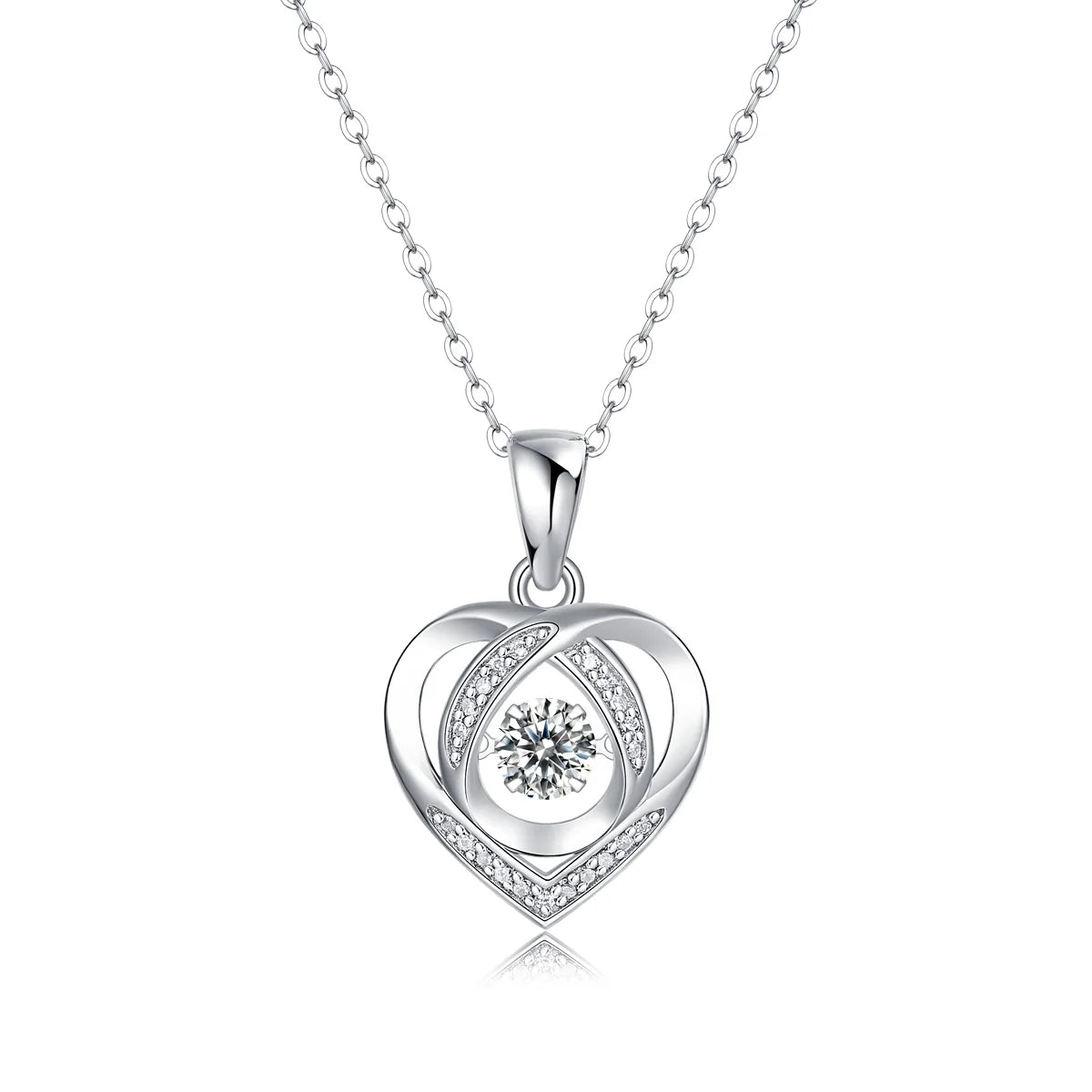
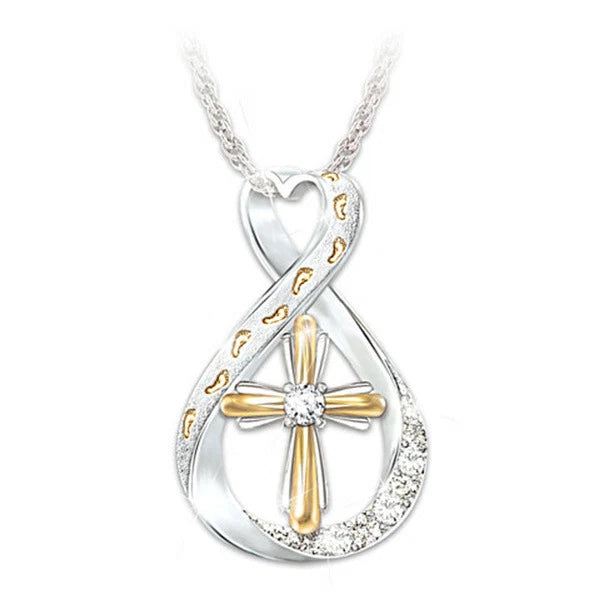
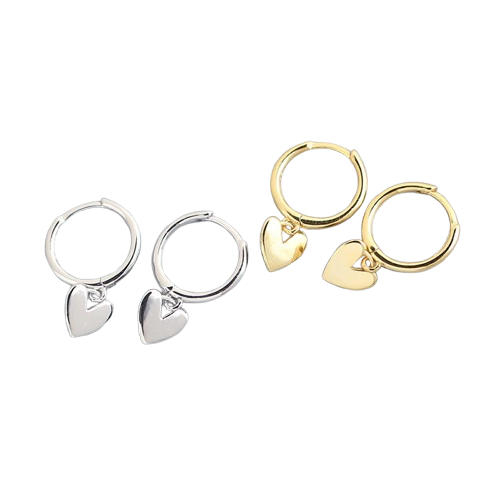
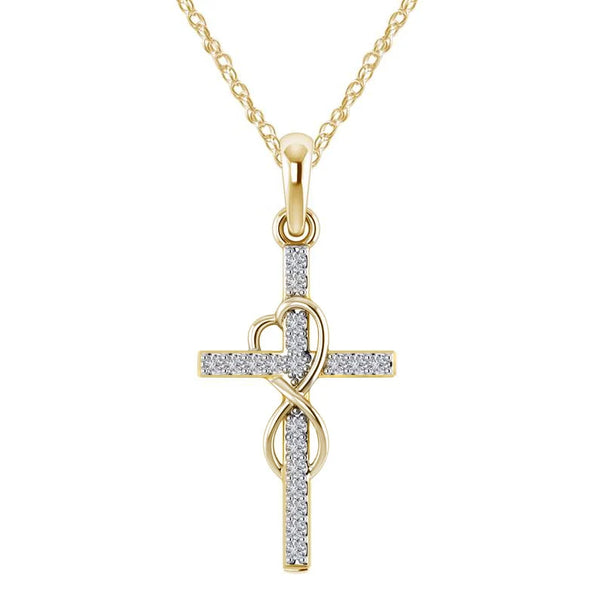
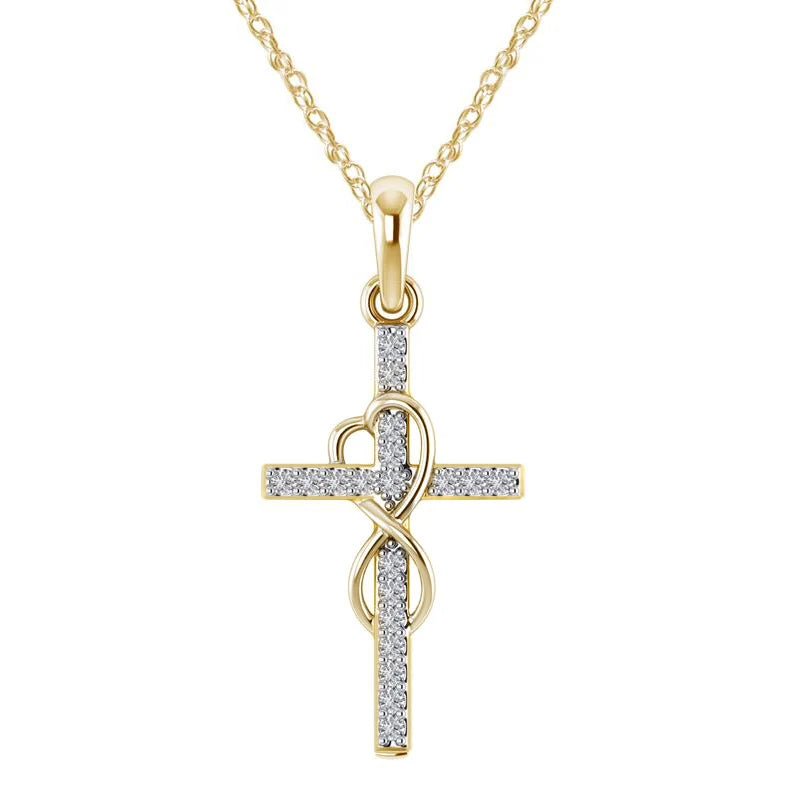
An infinity cross necklace is a pendant that combines a cross with the infinity symbol a horizontal figure-eight loop with no visible start or end point. The two shapes are worked together in a few common ways: the loop sitting just above or below the crossbar, the loop forming part of the cross's arms, or a slim infinity outline traced directly behind a smaller cross. It's also frequently layered with a third symbol, most often a heart similar to this infinity heart pendant which is how a piece can end up carrying three separate meanings faith, eternity, and love in one small pendant.
Because the loop and the cross are two independently recognizable symbols rather than one invented shape, the design reads clearly even to someone who has never seen this specific combination before it doesn't need an explanation the way an unfamiliar religious icon might. That legibility is a big part of why the style shows up equally in Christian gift shops and general fashion jewelry: the cross carries the faith message for people shopping with that in mind, and the infinity loop carries a secular “forever” message for people who aren't shopping with religion in mind at all.
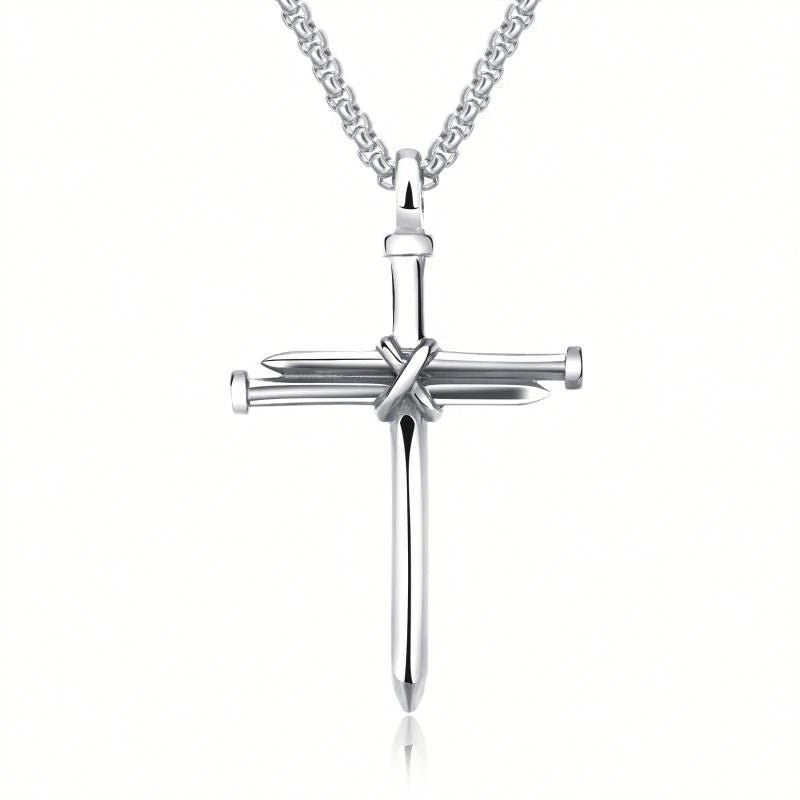
It's one of several distinct cross-necklace styles built to say slightly different things. A traditional crucifix depicts the figure of Christ on the cross and leans toward Catholic and Orthodox devotional tradition; a Celtic cross adds a circle over the crossbar and carries Irish and Celtic heritage alongside the faith message; a nail cross leans on three nails standing in for the crucifixion seen in this three-nail pendant design rather than an abstract shape; and a heart cross folds romantic love directly into the same faith message. The infinity cross is the one to reach for specifically when the message needs to include duration: not just what someone believes or feels, but how long they expect it to hold.
Where the Infinity Symbol Actually Comes From
The infinity symbol's history is worth separating from the cross's, because the two shapes come from completely different places and only met each other much later.
The symbol itself sometimes called a lemniscate, from the Latin lemniscus, meaning “ribbon” was introduced into mathematics by the English mathematician John Wallis in 1655, in his treatise De Sectionibus Conicis. Wallis used it as shorthand for a quantity with no limit, and it has stayed in that role in calculus and set theory ever since, describing things like the behavior of a function as it grows without bound.
It's common to come across the claim that the shape was inspired by a Möbius strip, the twisted-paper loop with only one continuous surface. It's a genuinely close visual match, but the timeline doesn't actually support it as an origin story: the mathematician the strip is named for wasn't born until roughly 135 years after Wallis introduced the symbol, so that connection is better understood as a coincidence of shape than an actual design source even though it still gets repeated as fact in a fair amount of jewelry and symbolism writing.
A separate, older idea often gets folded into infinity symbolism in jewelry marketing: the ouroboros, an ancient image of a serpent eating its own tail, used across several ancient cultures to represent a cycle with no clear beginning or end. The ouroboros and the mathematical lemniscate are two different symbols with two different origins one ancient and pictorial, one seventeenth-century and mathematical but they get grouped together because they gesture at the same basic idea: continuity without a stopping point.
What matters for a cross necklace specifically is this: on its own, the infinity symbol carries no built-in religious content. Its popularity in modern jewelry, especially in rings and necklaces marking a relationship, friendship, or family bond, is largely a twentieth- and twenty-first-century development, not an ancient religious tradition. Any spiritual or Christian meaning it carries in a piece like this comes entirely from what it's paired with which is exactly what happens once it meets a cross.
What Happens When the Loop Meets the Cross
A plain cross, worn on its own, already communicates an ongoing commitment to faith that part doesn't need the infinity symbol to work. What the loop adds is a second, more specific claim layered on top of the first: not just faith, but faith with no expiration attached to it.
That's a subtle but real shift in emphasis. A cross by itself is a statement about what someone believes. A cross with an infinity loop worked into it is a statement about how long that belief, or that love, or that bond is meant to hold which is why the same basic design shows up in three fairly different gifting contexts: a confirmation or baptism gift, where the emphasis lands on faith; an anniversary or relationship gift, where it lands on love; and a remembrance gift, where it lands on a connection that a loss hasn't broken. The cross stays constant across all three. The infinity loop is what stretches the promise out past a single moment.
Faith: What the Loop Adds to a Cross Someone Already Wears
For most people who wear a cross regularly, it isn't a statement piece it's closer to a daily habit, the same category of object as a watch or a wedding ring, put on without much deliberation each morning. Faith worn as a quiet, constant habit is, by a wide margin, the most common reason people give for wearing a cross at all, ahead of any single dramatic reason.
Adding the infinity symbol to that habit doesn't change what the cross means. It reframes how permanent the habit feels. A plain cross can fairly be read as “this is what I believe right now.” An infinity cross reads more like “this isn't something I expect to change” a small but meaningful difference for someone choosing a piece to mark a specific commitment: a confirmation, a baptism, a return to faith after time away occasions covered in our Christian gift guide or simply a milestone where “still believing, still here” is exactly the sentiment being marked.
Protection: Why “Never-Ending” Changes How the Promise Reads
A lot of people describe feeling more protected while wearing a cross, and it's worth being precise about where that feeling actually comes from. No mainstream Christian tradition teaches that the metal itself wards anything off; any sense of protection is a byproduct of faith, not a property of the object.
What the infinity loop adds to that idea is specific and worth naming on its own. If the cross represents a claim that protection ultimately comes from something beyond the wearer, the infinity symbol reinforces that the claim isn't provisional it isn't protection “for now” or “as long as this necklace holds up.” It works something like a wedding ring works in a marriage: the object doesn't create the security, but it represents a commitment framed as ongoing rather than temporary, and noticing it can pull someone's attention back to that commitment on a hard day. The loop doesn't change what's doing the protecting. It changes how long the promise behind it is being described as lasting.
Remembrance: When the Necklace Is About a Bond, Not Just a Belief
Outside of faith and protection, the third common reason people reach for an infinity cross is remembrance marking a bond that a loss, a distance, or the passage of time hasn't actually broken. This is where the infinity symbol does most of its work on its own, separate from the cross. In secular jewelry generally, an infinity pendant is one of the most common ways to mark a connection to someone no longer physically present: a parent, a sibling, a friend, a child. The loop's lack of a visible start or end point maps directly onto the idea that a relationship, or a memory, keeps going even after the circumstances around it have changed.
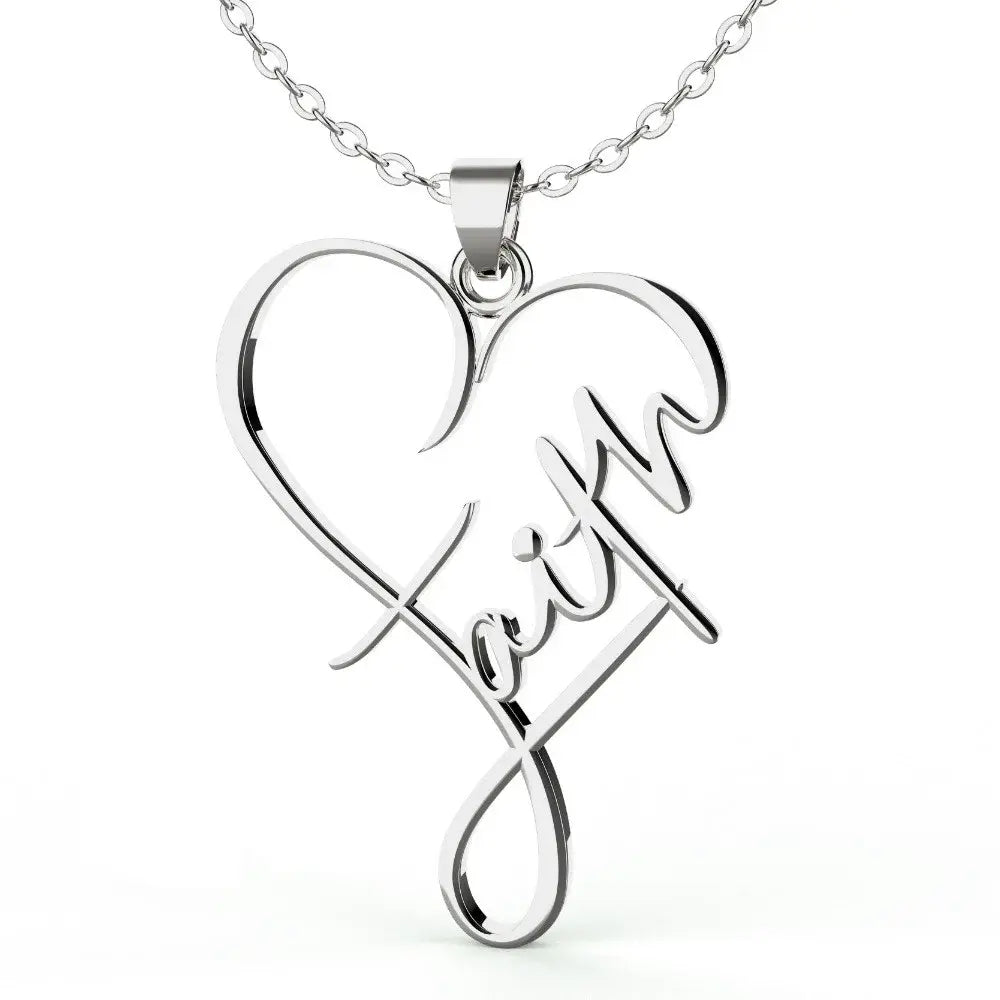
The cross adds a specific layer on top of that general symbolism: not just that the bond continues, but a particular Christian framing of why a hope grounded in resurrection rather than in memory alone. Some infinity cross designs draw directly on the well-known “Footprints in the Sand” story reflected in this Footprints-style pendant design where the absence of a second set of footprints during the hardest stretch turns out to mean being carried rather than being left alone. A remembrance piece built around that story is doing something slightly different from one built purely around romantic commitment it's speaking to comfort during a hard season more than to a relationship milestone, which is worth knowing before choosing between the two as a gift.
Is a 925 Sterling Silver Infinity Cross Necklace Worth It?
This is where most buying decisions on this style actually get made, so it's worth answering directly rather than in vague terms.
A “925” or “sterling” stamp means a piece is made from sterling silver: 92.5% pure silver alloyed with a small amount of another metal, almost always copper, which gives soft, pure silver enough strength to hold its shape through daily wear. It's a specific, verifiable standard genuine sterling silver carries that stamp somewhere on the piece, typically on the clasp or the back of the pendant, and a listing that won't name its base metal at all is worth reading more carefully before buying.
Solid sterling silver has one real advantage over a gold-tone or silver-tone plated finish: the metal itself is precious all the way through, rather than a thin decorative layer sitting on top of a different base metal. Plating wears thin with enough daily contact, sweat, and friction, eventually showing the base metal underneath as a dulling or a slight color shift. Sterling silver doesn't have that failure mode but it isn't maintenance-free either. Silver tarnishes on contact with air and skin oils over time, which means a sterling silver infinity cross needs occasional polishing to stay bright, unlike stainless steel, which resists tarnish without any upkeep at all.
Skin sensitivity is the other reason people search specifically for sterling silver. Nickel allergy affects a meaningful share of the population peer-reviewed dermatology research generally puts it in the range of roughly 15 to 20% of women and 3 to 5% of men, with the higher rate in women largely tied to earlier and more frequent jewelry exposure through piercings. Genuine sterling silver is a low-reactivity choice for that group, because the alloy is built around silver and copper rather than nickel. Cheap, unmarked “gold-tone” or “silver-tone” costume jewelry is the more common source of nickel exposure, not marked precious metal so if sensitivity is the actual concern, the word to look for is the material name itself, not the color.
Here's what that trade-off actually looks like laid out plainly, by finish rather than by any single product:
Worth flagging directly, since it's a genuine point of confusion in how this style gets marketed: some designer-tier pieces sold under a name like “infinity cross” actually use a single, seamless, unbroken cross line rather than a literal figure-eight symbol set against a cross. If the specific look being pictured is an actual infinity loop paired with a cross, that kind of continuous-line design is a different design language entirely worth confirming before assuming a familiar product name describes the design covered here.
One honest note worth making plainly: infinity-cross styles are frequently sold in gold-tone and two-tone finishes rather than solid sterling silver, and a trustworthy product listing will say so directly in the material description. If solid sterling silver is a non-negotiable, that's worth confirming on any infinity cross before buying, rather than assuming it from the word “silver” in a product name alone.
Obsessed Believer's cross necklace collection is built around this exact trade-off, so every finish gold-tone, two-tone, or solid sterling states itself plainly rather than leaving you to guess.
How to Choose the Right One
Chain length. Most infinity cross pendants sit best on a 16 to 18-inch chain for a collarbone-length look that keeps the pendant visible rather than tucked under a collar, or 20 to 22 inches if the plan is to layer it with other necklaces. Matching chain length to neckline and pendant size matters more than most buyers expect a pendant that looks delicate on a mannequin can disappear into a high neckline or look oversized on a low one.
Finish. Gold-tone and two-tone finishes offer more color options at a lower price point but wear thin with heavy daily contact; sterling silver holds its value and doesn't wear through but tarnishes and needs occasional polishing; stainless steel resists both problems at the cost of fewer finish options. Which one wins depends on whether the priority is look, longevity, or upkeep.
Design. A plain infinity cross keeps the message focused on faith and duration. Adding a heart into the same combination like this CZ heart cross pick layers love and romantic commitment into the same piece. A Footprints-style infinity cross shifts the emphasis toward comfort and being carried through a hard season. Matching the design to the actual occasion rather than choosing on looks alone is what makes a gift like this land the way it's meant to.
Frequently Asked Questions
What does an infinity cross necklace mean?
It combines the cross's message about faith with the infinity symbol's message about something that never ends most often read as faith, love, or a bond meant to last a lifetime.
Does the infinity symbol have a religious meaning on its own?
No. It comes from seventeenth-century mathematics and carries no built-in religious meaning by itself; any Christian meaning it carries comes from being paired with the cross.
What does the Bible say about wearing a cross or infinity necklace?
Nothing directly scripture doesn't instruct believers to wear a cross as jewelry, and it doesn't forbid it either. Wearing one is a tradition that developed over centuries of Christian practice, so most denominations treat it as a matter of personal conviction rather than a command.
What's the difference between an infinity necklace and an infinity cross necklace?
A plain infinity necklace signals a general, secular idea of forever a bond, a friendship, a milestone. An infinity cross necklace adds a specific Christian faith layer on top of that same idea by pairing the loop with a cross.
Is an infinity cross necklace the same thing as an eternity necklace?
Not quite. “Eternity necklace” is a broader term for any piece symbolizing something unending, while an infinity cross specifically adds Christian faith symbolism to that idea.
What does an infinity heart cross necklace mean?
It layers a third symbol, the heart, onto the same combination, typically read as faith, love, and eternity together a common anniversary or Valentine's Day gift.
Is it okay for Christians to wear an infinity symbol?
Yes. On its own the infinity symbol is a neutral mathematical shape with no conflicting religious history, and once it's paired with a cross it takes on a straightforwardly Christian meaning rather than a competing one.
Why do people wear infinity cross necklaces?
Most wearers give one of three reasons: faith worn as a daily habit, a felt sense of ongoing protection, or remembrance of a bond, a loss, or a milestone that hasn't ended.
Is sterling silver better than a gold-tone finish for an infinity cross necklace?
Solid sterling silver won't wear thin the way plating does but tarnishes and needs occasional polishing; gold-tone costs less with more color options but the plating wears with heavy daily contact. Neither is more “correct” symbolically it comes down to budget, skin sensitivity, and upkeep.
Does an infinity cross necklace tarnish?
A solid sterling silver one will tarnish over time with air and skin contact and needs occasional polishing; a stainless steel one resists tarnish with essentially no upkeep; a gold-tone one shows wear as the plating thins rather than as tarnish.
What's a good occasion to give an infinity cross necklace as a gift?
Confirmations and baptisms for faith, anniversaries and Valentine's Day for love, and remembrance gifts after a loss for a bond that continues.
How long should the chain be on an infinity cross necklace?
16 to 18 inches for a collarbone-length look, or 20 to 22 inches for layering with other necklaces.
Can an infinity cross necklace be worn to remember someone who has passed away?
Yes it's one of the more common reasons people choose this style, since the loop's lack of a start or end point is widely used in remembrance jewelry for a bond a loss hasn't ended.
The Short Version
Strip away the marketing language around this style and the actual idea is fairly simple: a cross says what someone believes, and the infinity loop says how long that belief or that love, or that bond is meant to hold. Whichever reason brought a reader here, faith, protection, or remembrance, that's the throughline running underneath all three.

 FREE SHIPPING ALL OVER USA