In 1979, archaeologist Gabriel Barkay was digging in a burial cave near Jerusalem when his team found two tiny rolls of silver, no bigger than a quarter. It took years of careful work to unroll them without destroying them. Inside, scratched in ancient Hebrew, was a version of the blessing in Numbers 6:24–26: “The LORD bless thee, and keep thee.” Scholars date the scrolls to about 600 BC, which makes them the oldest known text from the Bible. And they were made to be worn. Researchers believe they hung around someone’s neck.
That detail is the idea behind this guide. A blessing on a chain is not a gift-shop invention. People have been wearing Scripture close to the body for more than 2,600 years.
Search for unique birthday gifts for women of faith and you will mostly find blankets, tumblers, candle sets and gift baskets: mass-produced novelty with a Bible verse printed on it. Novelty is not meaning. This guide takes the other route. It explains where the habit of wearing faith comes from, how to choose Christian faith jewelry that fits the woman you are buying for, which questions to settle before you spend anything, and how to write the blessing that turns a necklace into a gift she keeps.
Quick Answer
The best unique birthday gift for a woman of faith is a piece of Christian faith jewelry chosen for what she believes and given with a handwritten blessing. Settle three things first: whether her tradition celebrates birthdays, whether it wears jewelry, and whether she prefers a plain cross or a crucifix. Then match the design to what her faith centers on (a nail cross for redemption, an infinity cross for everlasting love, a heart cross for love rooted in faith), check the metal if her skin is sensitive, and write one line of blessing for each part of Numbers 6:24–26.
The two silver scrolls come from Ketef Hinnom, a hillside of First Temple–era tombs overlooking the Hinnom Valley, across from Mount Zion. When a team from the Israel Museum finally unrolled them, they found tiny lines of ancient Hebrew script that repeat the priestly blessing in a shorter form and include the divine name. The date most scholars accept is the late seventh century BC, which puts the scrolls centuries before the Dead Sea Scrolls.
Two details matter for a gift. First, the blessing was carried, not displayed. The scrolls were tiny, rolled tight, and most likely worn around the neck, which is why archaeologists call them amulets. Second, the words were written on silver. Someone chose a precious metal for the thing they most wanted to keep near them.
Numbers 6:27 fits the picture. After the blessing itself, God says of the priests: “And they shall put my name upon the children of Israel; and I will bless them.” Some scholars read that verse as reflecting an ancient practice of physically wearing God’s name and blessing. Whether or not that reading is right, the silver scrolls show that at least one person in ancient Judah carried the blessing on the body.
One clarification belongs here, because “amulet” is a loaded word. Mainstream Christian teaching holds that no metal protects, saves or blesses. God does. Faith jewelry works as a reminder and a witness, the way a wedding ring reminds and testifies, not as a talisman. That is also the healthiest way to give it: the necklace points to the blessing; it is not the blessing.
What Scripture Says About Keeping Words and Signs Close
The Bible returns to the same picture again and again. Deuteronomy 6:8 tells Israel to bind God’s words “for a sign upon thine hand.” Proverbs 3:3 says to bind mercy and truth “about thy neck” and to write them “upon the table of thine heart,” and Proverbs 6:21 repeats it: “Bind them continually upon thine heart, and tie them about thy neck.” In the Song of Solomon, love asks to be worn as a seal: “Set me as a seal upon thine heart, as a seal upon thine arm” (8:6).
Readers disagree about how literally to take the neck-and-heart language in Proverbs; many treat it as a figure of speech for keeping teaching close. Either way, the picture is consistent. What matters most is kept near the body and near the heart, where you see it and feel it. That is exactly what a necklace does.
How Christians Came to Wear Their Faith
Around the year 200, Clement of Alexandria gave Christians practical advice about the seals on their signet rings. Choose a dove, a fish, a ship under sail, a lyre or an anchor, he wrote, not the idols common on Roman rings. The advice was about more than taste. He wanted the small objects a believer wears to say something true about the person wearing them.
The cross came to the jewelry box later. Tertullian, writing around 204, describes Christians tracing the sign of the cross on their foreheads before almost any action, but the cross as a common Christian image spread in the fourth century. By then believers were wearing small crosses on the chest, often called encolpia, and some held relics.
Today the habit is widespread. In a 2023 Pew Research Center survey, 36 percent of U.S. adults said they have a cross for spiritual reasons, including 72 percent of Catholics and 42 percent of Protestants. Another 19 percent said they have jewelry of some kind for a spiritual purpose. Those figures count owning a cross, not wearing one every day, but they show how common it is to treat a small object as a personal statement of belief. For a longer look at the everyday side of that habit, see why people wear a cross.
Why Christian Faith Jewelry Suits a Birthday
A birthday is a natural place to start with Scripture, because the Bible speaks directly about the day a person begins. In Psalm 139, David praises God for knowing him from the womb: “I will praise thee; for I am fearfully and wonderfully made” (Psalm 139:14, KJV). Psalm 90:12 asks the question every birthday raises: “So teach us to number our days, that we may apply our hearts unto wisdom.” And Numbers 6:24–26 gives a blessing for the year ahead.
Read together, they give a birthday three jobs: thanks for a life (Psalm 139), an honest look at time (Psalm 90) and a blessing for what comes next (Numbers 6). A gift does the third job best when it lasts through the year. Faith jewelry does. A pendant is worn on ordinary days, at the sink, in traffic, in hospital waiting rooms, and each time she puts it on, the blessing you attached to it is there again.
The research on gift giving supports the matching approach. In six experiments, Mary Steffel and Robyn LeBoeuf found that people shopping for several recipients often skipped the gift each person would most have liked and chose something different for everyone, because they wanted each person to feel unique. The result was gifts that were distinctive but less preferred. The experiments involved shoppers buying for several people, but the lesson carries over: effort spent on being different can crowd out effort spent on being right. For a woman of faith, being right means fitting what she believes. Unusual comes second.
One finding cuts the other way, and it deserves honesty. Cindy Chan and Cassie Mogilner found that experiential gifts, such as a shared event, strengthened relationships more than material gifts did. A necklace is a material gift. The practical answer is to attach an experience to it: hand it over in person and read her the blessing aloud. That is our reading, not the study’s conclusion, but it fits the data. The moment of giving carries the emotion, and the necklace keeps it.
Three Checks Before You Choose Religious Jewelry for Women
Faith jewelry is personal in a way most gifts are not. Settle these three questions first. Each one can turn a thoughtful gift into an awkward one.
1. Does her tradition celebrate birthdays?
Scripture neither commands nor forbids birthday celebrations. It records two birthdays by name, Pharaoh’s in Genesis 40:20 and Herod’s in Mark 6:21, and both stories end in a death. Some traditions read that as a warning. Most do not, and Paul’s principle about special days in Romans 14:5 is often applied here: “Let every man be fully persuaded in his own mind.”
The objection is old. In the third century Origen argued that no saint in Scripture held a birthday feast. But researcher David Brattston, writing in the Christian Research Journal, surveyed the surviving Christian literature written before AD 249, about five hundred works by about a hundred authors, and found an ethical objection to birthdays in only one of them: Origen. That suggests it was never the mainstream view.
Today the clearest example is Jehovah’s Witnesses. Their official site JW.org says they do not celebrate birthdays, and it also says they do not use the cross in worship. A few smaller groups, such as the Living Church of God, also teach against birthday celebrations. A cross necklace for a birthday would miss twice with a Jehovah’s Witness. If she belongs to a community with these convictions, or you are not sure, ask someone close to her before you buy, or give her a written blessing and a promise of prayer instead.
2. Does her tradition wear jewelry?
Two New Testament passages shape this question: “women adorn themselves in modest apparel… not with broided hair, or gold, or pearls, or costly array” (1 Timothy 2:9, KJV) and “Whose adorning let it not be that outward adorning of plaiting the hair, and of wearing of gold… But let it be the hidden man of the heart” (1 Peter 3:3–4, KJV). Most Christian traditions read these as teaching about modesty and priorities, not a ban, in part because the same verses also mention clothing. A smaller number of communities, including some Apostolic Pentecostal, Brethren and Plain churches, avoid ornamental jewelry altogether.
The practical test is simple. If you have never seen her wear a necklace, earrings or a cross, that is information. Ask someone close to her before you buy.
3. Cross or crucifix?
A plain cross and a crucifix, which carries the figure of Christ, are both meaningful, and traditions lean differently. Many Catholic and Orthodox Christians prefer a crucifix, while many Protestants wear a plain cross. If you are not sure which she would call her own, ask, or look at what she already wears. Our cross necklace collection is built around plain-cross and symbol designs, so if she wears a crucifix, confirm before choosing a cross.
Choosing Christian Faith Jewelry by What Her Faith Centers On
The word cross covers several designs, and each one leans on a different idea. Religious jewelry for women is at its best when the design says something she would say herself, so start with what her faith centers on and work backward to the pendant. The meanings below are the traditional and commonly held ones, the same ones our product pages use. They are not doctrine, and if she has her own reading of a symbol, hers wins.
| If her faith centers on… |
Design to consider |
Scripture for the card (KJV) |
| The cost of redemption |
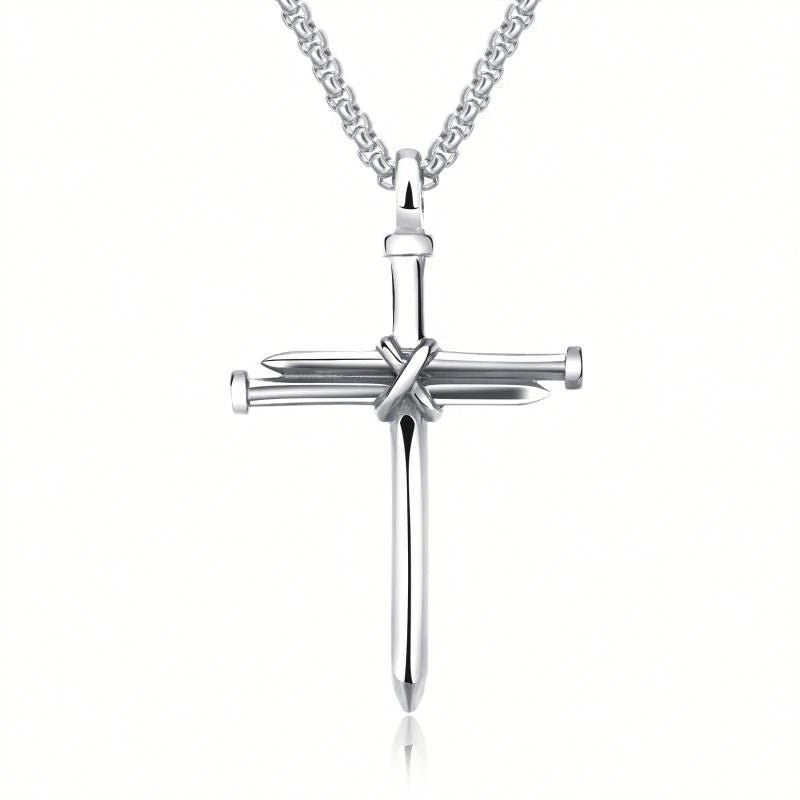
Stainless steel nail cross or two-tone nail cross with CZ accent |
Isaiah 53:5: “he was wounded for our transgressions” |
| Everlasting love |
Gold-tone infinity cross or infinity heart cross |
Jeremiah 31:3: “I have loved thee with an everlasting love” |
| Comfort in a hard season |
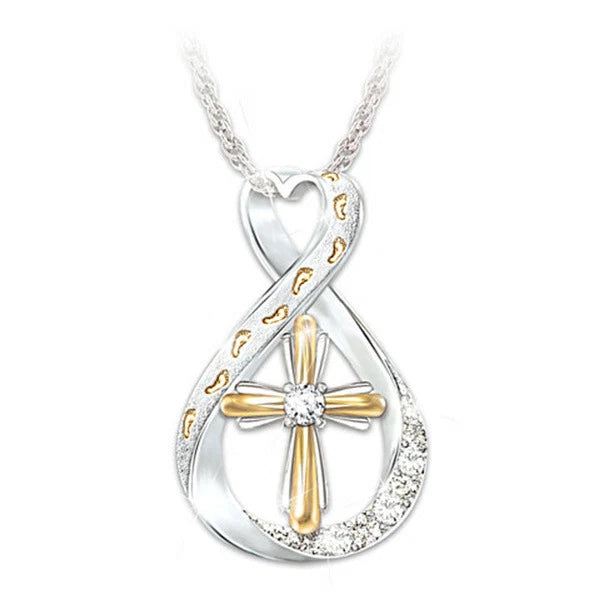
Footprints infinity cross |
Deuteronomy 31:8: “he will not fail thee, neither forsake thee” |
| Love rooted in faith |
CZ heart cross in stainless steel or two-tone cross heart pendant |
1 John 4:19: “We love him, because he first loved us” |
| Protection and being watched over |
Angel wing cross |
Psalm 91:4: “under his wings shalt thou trust” |
| Celebration and gratitude for her life |
CZ pave cross in gold tone or silver tone |
Psalm 139:14: “fearfully and wonderfully made” |
| Steadiness, something that feels inherited |
Vintage cross in antique silver with onyx |
Hebrews 13:8: “Jesus Christ the same yesterday, and to day, and for ever” |
| Faith as a word she wants to wear |
Faith script cross or silver faith heart necklace |
2 Corinthians 5:7: “we walk by faith, not by sight” |
The nail cross. Three nails form the cross, so the design points directly to the crucifixion instead of suggesting it. It is a bolder, more deliberate pendant than most, which makes it a considered gift for a woman for whom redemption is the center of belief. The stainless steel version comes in silver or gold color.
The infinity cross. The infinity symbol lays “everlasting” over the cross. On the gold-tone version, the product image lists the pendant at about 2.3 cm (roughly 0.9 inch) tall, so it sits in everyday territory rather than statement territory. For a longer read on what the symbol adds, see what the infinity symbol adds to the cross.
The footprints cross. This design is inspired by the “Footprints in the Sand” poem, a twentieth-century devotional poem, not Scripture. That is the reason to put a verse on the card. Pair it with Deuteronomy 31:8 or Psalm 23:4 and it becomes a gift for a friend in a hard season that rests on the Bible, not on the poem.
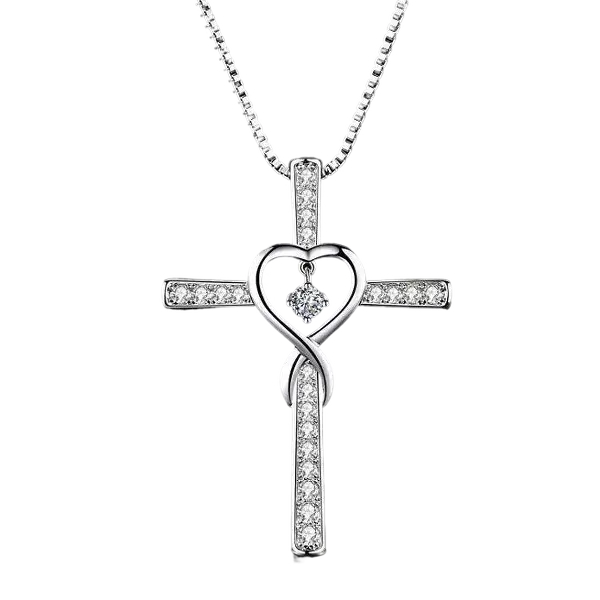
The heart cross. A heart set with the cross joins love and faith in one pendant. It suits a woman whose faith is warm and relational, and it is one of the few designs that works as both a birthday and an anniversary gift.
The angel wing cross. Wings lean on protection and comfort. Take them as a reminder of Psalm 91, not as a guarantee. It fits someone who needs to hear that she is not carrying a hard season alone.
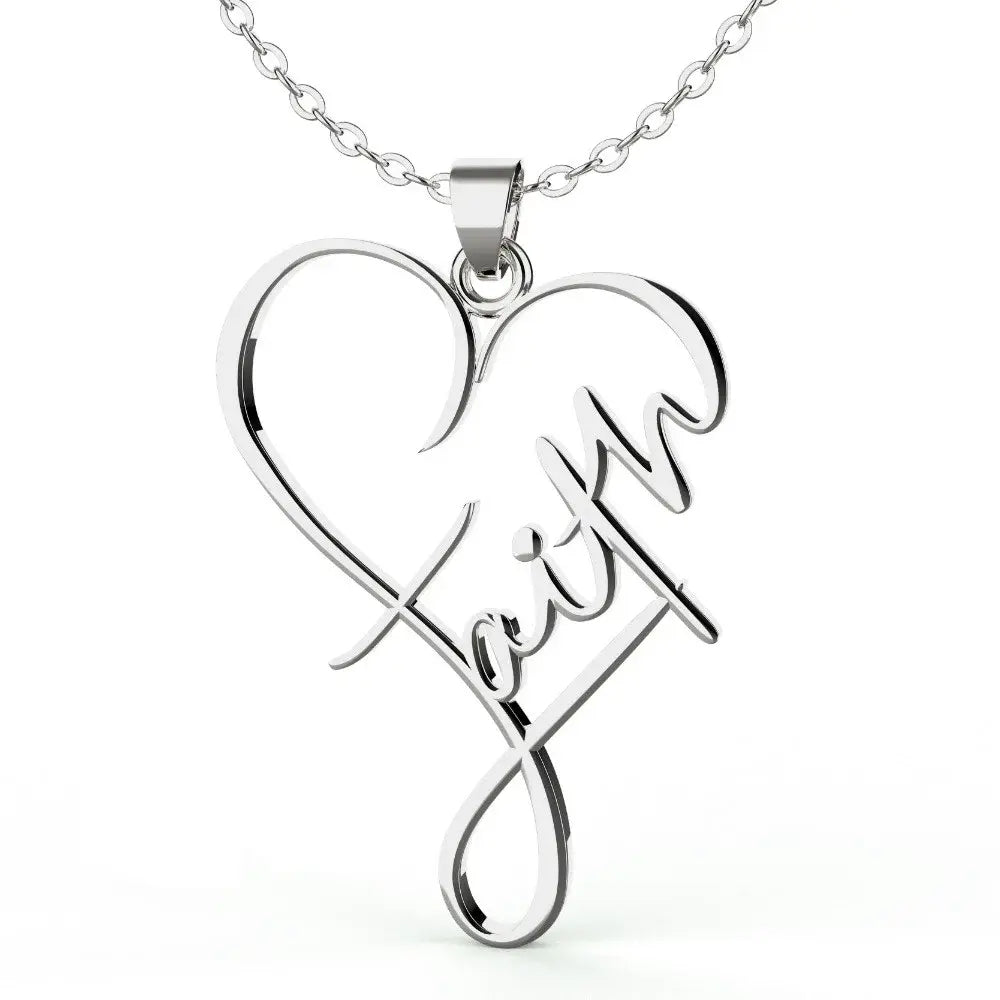
Pave, vintage and script designs. These are less about a single idea and more about her style. A CZ pave cross is brighter and dressier. An antique-silver cross with onyx reads heavier and more like an heirloom. A script piece, where the word “faith” sits beside a small cross or heart, layers easily with a plain chain.
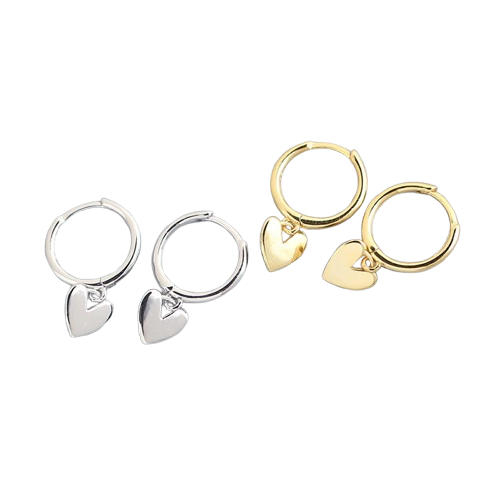
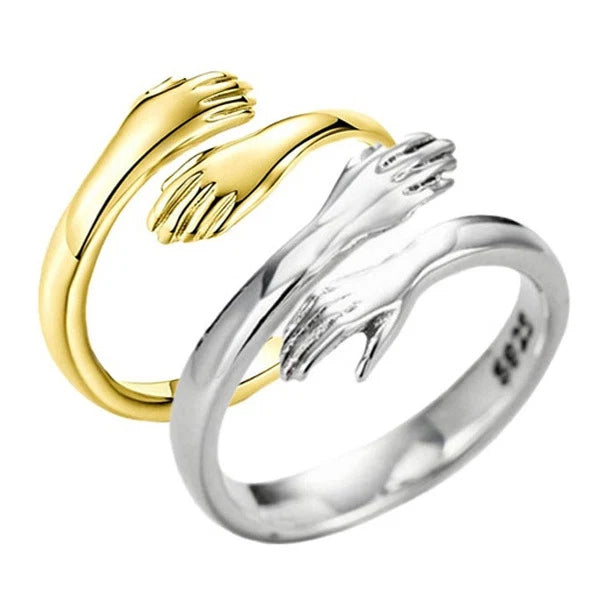
Across the cross necklace collection, prices currently run from $14.99 to $54.99 (checked September 29, 2026), with the stainless steel pieces at the upper end. If she does not wear necklaces, the store also has earrings and rings. For a wider look at faith pieces for everyday wear, see everyday Christian jewelry for women.
Metal, Skin, Size and Care: What to Check Before You Buy
The metal
Read the material line on the product page, not just the title. Three finishes cover most faith jewelry. Stainless steel is strong and resists tarnish because there is no thin plating to wear through. Gold-tone or two-tone plating has a warmer look and costs less, but the layer can wear thin with years of daily contact. Antique or oxidized silver finishes are deliberately darkened and textured. Sterling silver is a different thing again: it is 92.5 percent silver and normally stamped “925.” A listing that says “silver-tone” or “silver-colored” without a 925 stamp is not sterling. For more on stainless steel specifically, see stainless steel cross necklaces for women.
Skin sensitivity
The American Academy of Dermatology estimates that more than 18 percent of people in North America are allergic to nickel. It advises wearing jewelry that is nickel-free, hypoallergenic, or made from metals such as surgical-grade stainless steel, 18-, 22- or 24-karat yellow gold, pure sterling silver or platinum, and the Mayo Clinic lists titanium as well. One caution: most stainless steel contains nickel locked into the alloy, and grades vary. “Surgical-grade” is a good sign for most people, but it is not a guarantee for someone with a strong reaction. If she has ever reacted to earrings or a watch, ask the seller which grade a necklace uses before you order, or choose a different metal.
Size and chain length
A pendant under about 1 inch works for daily wear and layering. On chain length, 16 to 18 inches sits near the collarbone and is the most versatile, 20 to 22 inches is a relaxed everyday length, and 24 inches or more suits layering. An adjustable chain takes the guesswork out of a gift because she can set the length herself. Our metal, sizing and chain-length guide goes into more detail.
Care
Keep it dry and away from perfume and lotion, wipe it with a soft cloth, and take it off before showering, swimming or heavy exercise unless the listing says otherwise. Moisture and friction wear plating fastest, and chlorine is hard on most finishes.
Give It With a Blessing: How to Write One
The necklace is the object. The blessing is what makes it hers. Numbers 6:24–26, the priestly blessing, is the best pattern in Scripture because it was built to be spoken over one person:
“The LORD bless thee, and keep thee: The LORD make his face shine upon thee, and be gracious unto thee: The LORD lift up his countenance upon thee, and give thee peace.” (Numbers 6:24–26, KJV)
In Hebrew the blessing is three lines of three, five and seven words, fifteen words in all, with the name of the LORD once in each line. God is the actor in all six of its verbs: bless, keep, make his face shine, be gracious, lift up his countenance, give peace. And “thee” is singular. Each person who hears it is meant to take it as said to her.
One caution about authority. Numbers 6 gives the priests the words and says that God does the blessing (verse 27). A card cannot confer God’s blessing. What you can do is ask for it, in her name, in words she will recognize. That keeps the exercise honest, and it is why the card should sound like a prayer, not a pronouncement.
A five-line blessing you can adapt
Write one line for each theme, with a detail only you would know. The pattern is below with an example line for each. Replace every example with something true about her.
Bless what you are thankful for in her: May this year bless you with the rest you give everyone else.
Keep where she needs protection: May you be kept safe on every long drive home.
Shine light for the hard days: May you see his face shine on the days that feel dark.
Grace the mercy she gives freely: May you be shown the grace you show so easily.
Peace what you hope for her home and heart: May you have peace in your house and in your heart.
Copy the verse that matches her necklace from the design table on the back of the card, sign it, and add a promise: “I will pray for you by name each morning of your birthday month.” Write the dates on the card. It gives her something a purchase cannot, a commitment that continues after the party.
A psalm for her age
There are 150 psalms, so every birthday up to 150 has a chapter. If she is turning 27, read Psalm 27 and copy the line that sounds most like her. Some chapters are hard laments or cries for justice, such as Psalm 58 or Psalm 88. If her age lands on one, use a psalm of trust instead, such as Psalm 23 or Psalm 121. It takes ten minutes, and no one else will give her the same card.
Passages for milestone birthdays
| Turning |
Passage |
Theme |
| 30 |
Psalm 30:1–5 |
Joy after a hard season |
| 40 |
Psalm 40:1–3 |
Waiting, and a new song |
| 50 |
Psalm 103:1–5 |
Gratitude and renewed strength |
| 60 |
Psalm 71:17–18 |
God’s faithfulness from youth into later years |
| 70 |
Psalm 90:10–12 |
Numbering our days with wisdom |
| 80 and beyond |
Psalm 92:12–14 |
Still bearing fruit in old age |
How to hand it over
Give it in person if you can and read the blessing aloud. Research on gift giving finds that givers tend to focus on the moment of exchange, and here that habit works in your favor. If you cannot be there, record yourself reading the blessing and send the audio with the package. For a milestone birthday in her sixties or later, faith jewelry for a retirement milestone covers the same ground from another angle.
When Faith Jewelry Is Not the Right Gift
She does not share the faith. A cross carries a specific meaning, and it works only when that meaning is already hers. If you have never seen her wear faith jewelry or mention church or prayer, choose something else.
Her tradition points elsewhere. The Jehovah’s Witness example above is one case. Some conservative communities avoid ornamental jewelry, and many Catholic and Orthodox believers prefer a crucifix to a plain cross.
It does not fit how she dresses. Even the most meaningful pendant stays in its box if it does not suit her day. Look at an ordinary day of her life before you decide.
One question covers all three: would she call this hers? If you cannot say yes, give the blessing, the psalm and the promise of prayer without the necklace. They cost nothing and pass the same test.
Timing and Practical Details
Order at least three weeks before her birthday. Our store lists delivery in 10 to 12 days, and weekends, weather and carrier delays are real. US shipping is free, and the product pages list a 30-day replacement warranty, which matters because you cannot try a style on her before she opens it. Whatever store you use, read the delivery estimate and the replacement policy first. For more on choosing among faith gifts she can wear, see Christian gifts for women.
Frequently Asked Questions
What is a unique birthday gift for a woman of faith?
A unique birthday gift for a woman of faith is one that fits what she believes closely enough that she would recognize herself in it. Christian faith jewelry in a design she finds meaningful, given with a handwritten blessing, does that better than a novelty item. Unusual is easy to buy. Personal takes attention to her tradition and practice.
Is Christian faith jewelry a good birthday gift?
Yes, when she already values her faith and wears jewelry. The gift works because the symbol is one she recognizes as her own. Check whether her tradition celebrates birthdays and wears jewelry, match the design to what her faith centers on, and add a written blessing. If you have never seen her wear faith jewelry, give the blessing and a promise of prayer without the necklace.
What is the best religious jewelry for women as a gift?
There is no single best piece. The best one matches what her faith centers on: a nail cross for redemption, an infinity cross for everlasting love, a heart cross for love rooted in faith, an angel wing cross for comfort. When you are unsure, choose the simpler design on an adjustable chain.
Do Christians celebrate birthdays?
Most do. Scripture neither commands nor forbids birthday celebrations, and Paul’s principle about special days in Romans 14:5 is often applied to them. Origen is the best-known early Christian writer to object. Some groups, including Jehovah’s Witnesses, do not celebrate birthdays for religious reasons. If you are unsure of her tradition, ask someone close to her before choosing a gift.
What does the Bible say about birthdays?
It records two birthdays, Pharaoh’s in Genesis 40:20 and Herod’s in Mark 6:21, both in stories that end in a death. It also praises the gift of life in Psalm 139:14 and asks God to help us number our days in Psalm 90:12. It neither commands nor forbids celebrating.
What should I write in a birthday card for a woman of faith?
Write a short blessing instead of a generic line. The blessing in Numbers 6:24–26 offers a pattern: ask that she be blessed, kept, shown light, given grace and given peace, with a real detail from her life in each line. Handwrite it, and read it aloud if you give the gift in person.
How do I choose a Bible verse for a birthday?
Choose a verse that speaks to her season rather than a favorite that could be for anyone. One simple method is to read the psalm that matches her new age and copy the line that sounds most like her. You can also match the verse to her necklace: Jeremiah 31:3 for an infinity cross, Isaiah 53:5 for a nail cross, 1 John 4:19 for a heart cross. If her age lands on a hard lament, such as Psalm 88, use a psalm of trust instead.
Can Christian women wear jewelry?
Most Christian traditions say yes. They read 1 Timothy 2:9 and 1 Peter 3:3–4 as teaching about modesty and priorities, not as a ban. Some communities, including some Apostolic Pentecostal, Brethren and Plain churches, avoid ornamental jewelry altogether. If you have never seen her wear any, ask before you buy.
What is the difference between a cross and a crucifix as a gift?
A plain cross is empty; a crucifix carries the figure of Christ. Many Catholic and Orthodox Christians prefer a crucifix, while many Protestants wear a plain cross. Both are meaningful. If you are unsure, ask someone close to her or look at what she already wears.
Is stainless steel safe for a nickel allergy?
It depends on the grade and on how sensitive she is. The American Academy of Dermatology lists surgical-grade stainless steel among metals people can consider when avoiding nickel, but most stainless steel contains some nickel in the alloy and grades vary between pieces. If she has reacted to earrings or a watch, ask the seller which grade a necklace uses before you buy.
How far ahead should I order a necklace as a birthday gift?
At least three weeks. Our store lists delivery in 10 to 12 days, and you want a buffer for weekends and carrier delays. Check the delivery estimate and the replacement policy before you order anywhere.
A Gift She Recognizes as Hers
A birthday gift is unique when she can look at it and know it was chosen for her faith and for her. The oldest Bible text we have was worn close to the body by someone who wanted a blessing to stay near. A necklace and a handwritten card can do the same work today. If a cross fits her, browse our cross necklace collection. If it does not, the blessing, the psalm and the promise of prayer work with any gift, and with none.

 FREE SHIPPING ALL OVER USA