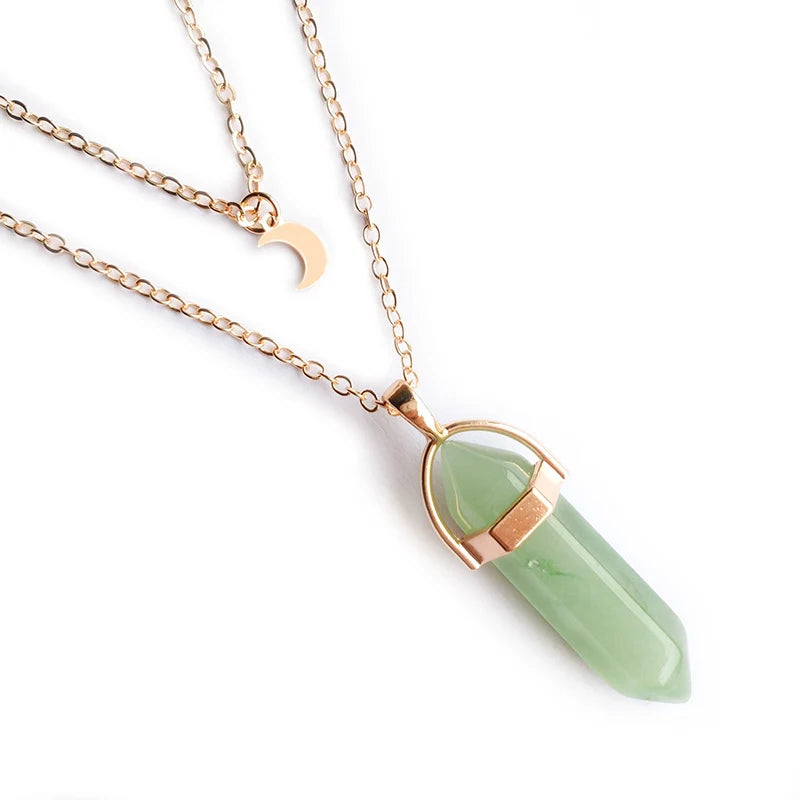
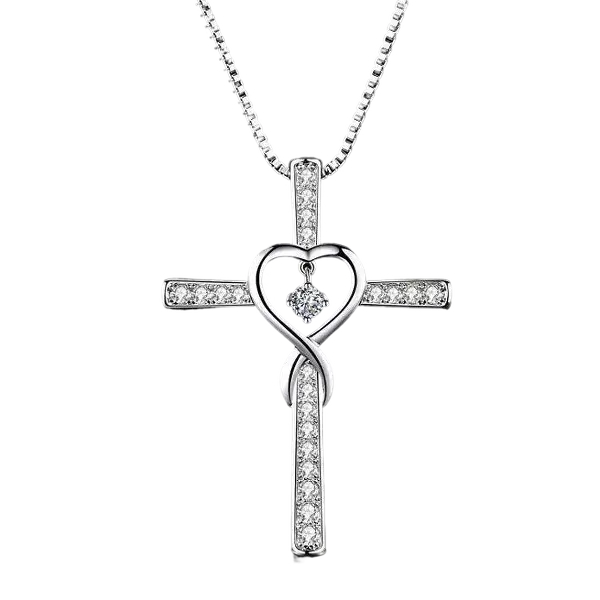
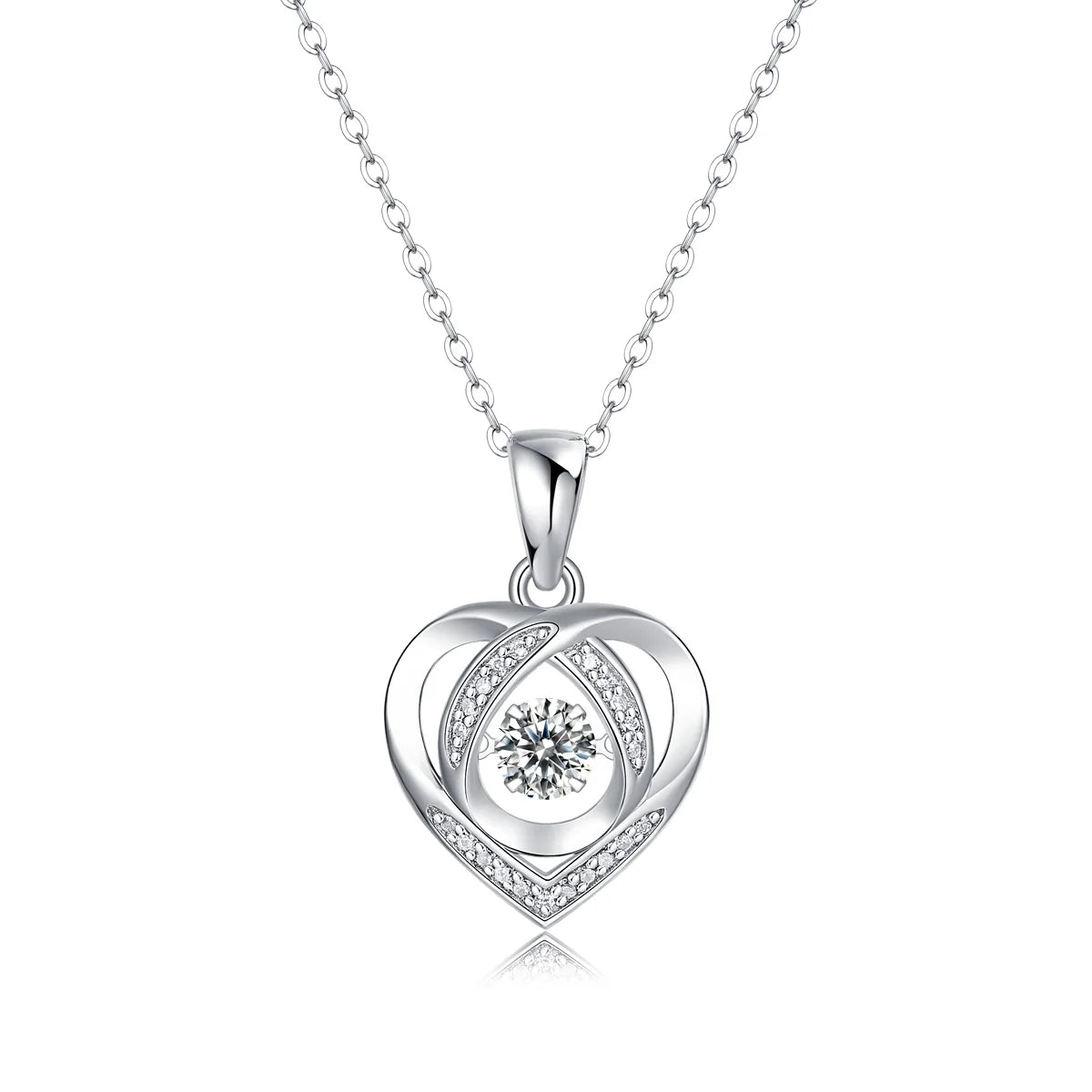
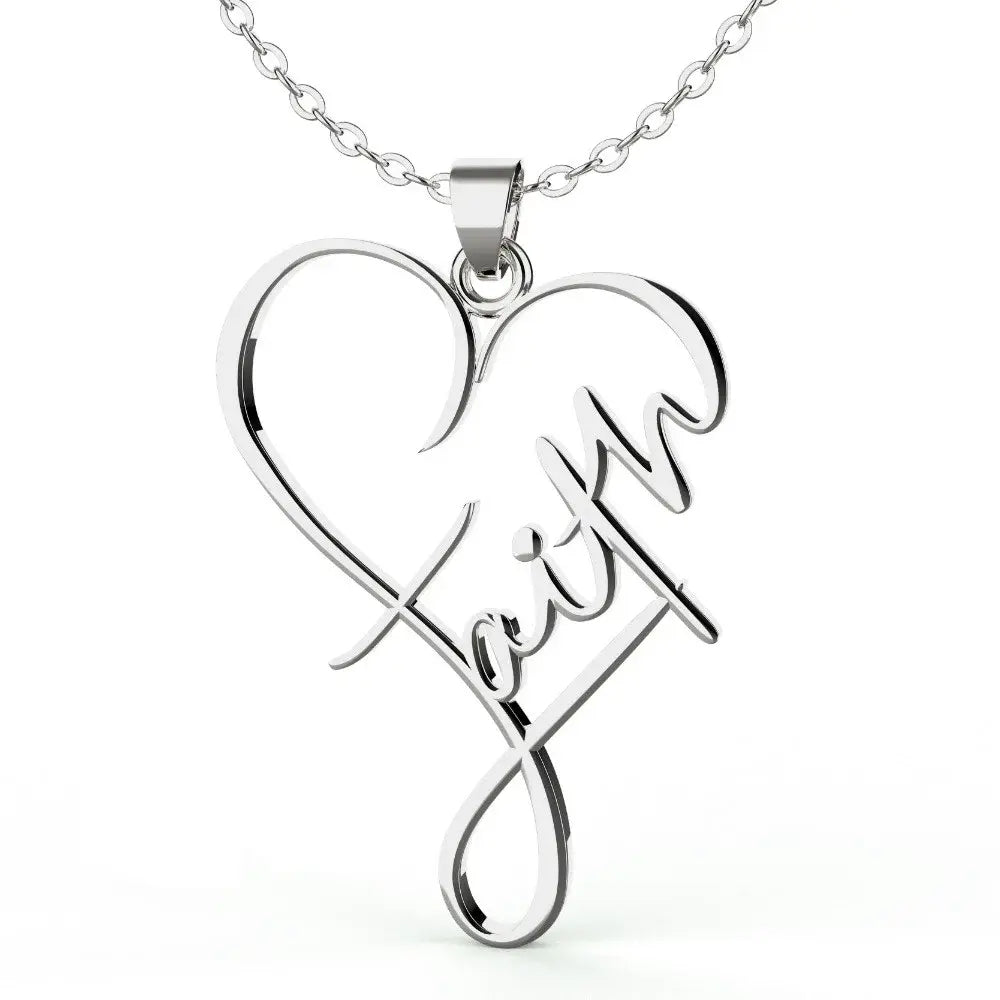
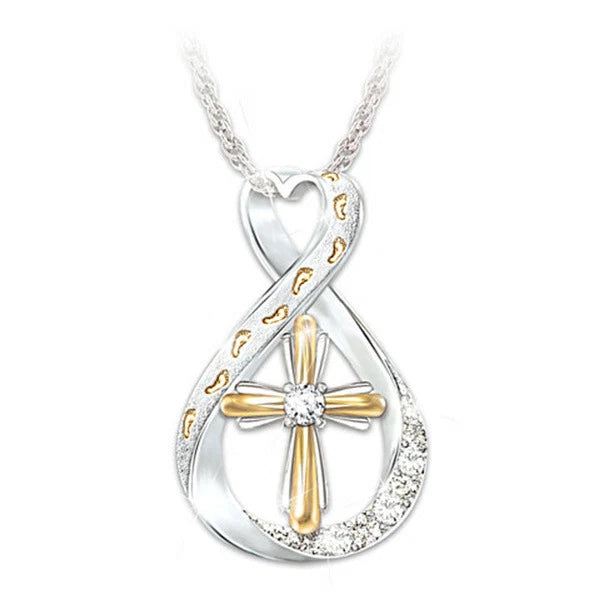
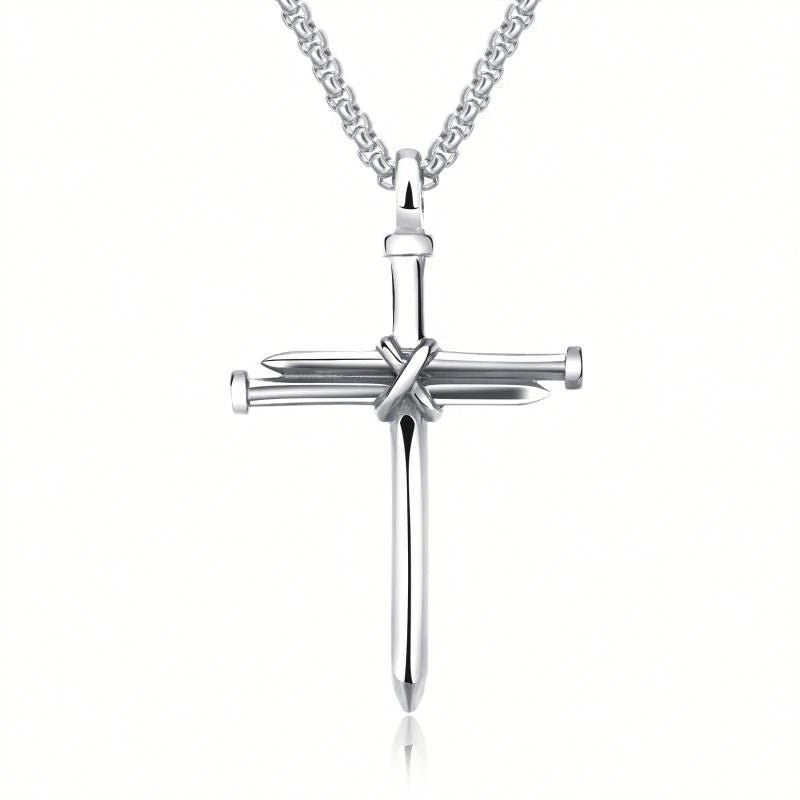
No mainstream church teaches that the metal itself repels anything. But the belief has survived for roughly seventeen hundred years for a real reason, a specific case in scripture for what the symbol is meant to do, and a documented psychological effect that makes the sense of protection genuine, even when the mechanism isn't magic. Whether it's a gold crucifix, a sterling silver pendant, or a simple stainless steel cross necklace worn every single day, the question comes back to the same thing: what is actually doing the work when someone puts one on?
A Symbol of Faith and Protection
Strip away the folklore and one idea holds up under scripture, history, and psychology alike: a cross necklace is a symbol of faith and protection in that order, not in reverse. Faith comes first; any sense of protection is a byproduct of it, not a property of the metal.
For a believer, the cross points to a specific claim that Christ's death and resurrection already accomplished victory over sin and evil and wearing it is a way of keeping that claim close, physically, all day. That's why someone can wear a plain stainless steel cross necklace to the gym and a family heirloom crucifix to church and get the same devotional value from both: the material changes, the faith it represents doesn't. The sense of being protected that people describe isn't imagined, either; it shows up in real psychological research on confidence and meaningful objects, covered in detail further down. But it starts with what the symbol represents, not with the object itself.
Two Different Claims, Folded Into One Question
"Does a cross necklace protect you from evil" is really asking two separate things, and the answer depends on which one is meant.
The first is a magical claim: that the object itself carries protective force, the way a lucky charm is supposed to work independent of anyone's belief in it. Christian theology rejects this directly. Treating a physical item as having power of its own is, by the Church's own definition, superstition rather than faith.
The second is a devotional claim: that wearing the symbol keeps faith visibly present in daily life, and that faith not the metal is where any real protection is thought to originate.
Mainstream Christian teaching lands on the second interpretation. A cross necklace works something like a wedding ring works in a marriage: it doesn't create the commitment, but it represents one that already exists, and noticing it can pull someone's attention back to that commitment in the middle of an ordinary day. That's a fundamentally different function than a talisman performs, even though both might be worn around the neck for similar emotional reasons.
Where the Instinct to Wear Protective Symbols Comes From
Wearing something small for protection didn't start with Christianity. Anthropologists call this general pattern apotropaic magic, from the Greek word for "turning away" harm. Ancient Egyptians carved protective wands from hippopotamus ivory to guard newborns, and used the ankh, a cross with a looped top, as a symbol of life and protection long before Christianity existed. Ancient Greeks and Romans wore amulets shaped like eyes and open hands specifically to deflect envy. The belief that a symbol can turn away misfortune shows up independently across dozens of unconnected cultures on nearly every continent, which points to something important: this is a human instinct, not a specifically religious one. Christianity inherited an impulse that already existed and gave it a different theological explanation.
The Cross Wasn't Always a Christian Symbol Or Even a Safe One

Here's where a lot of popular accounts get the story wrong: they assume the cross was Christianity's protective emblem from the moment of the crucifixion onward. It wasn't.
For roughly the first three centuries of Christianity, while Roman persecution made simply being identified as a believer dangerous, Christians largely avoided displaying the cross at all. It was, after all, Rome's method of executing criminals, and putting it on open display invited exactly the wrong kind of attention. Historians note that explicit images of the crucifixion are almost entirely absent from Christian art of this period.
Instead, believers used more ambiguous symbols: an anchor, a dove, and especially the fish, or ichthys. The Greek letters spelling "fish" doubled as an acronym for "Jesus Christ, God's Son, Savior," and tradition holds that strangers would use it as a quiet way to identify each other: one person would trace a single curved line in the dirt, and if the other completed it into a fish shape, both knew they were speaking to a fellow Christian.
That changed with Emperor Constantine. Before a decisive battle in 312 AD, Constantine reportedly had his soldiers mark their shields with the Chi-Rho, a monogram made from the first two Greek letters of "Christ" after what he described as a vision. Following his victory and conversion, Constantine legalized Christianity and abolished crucifixion as a method of execution. The Chi-Rho became the empire's dominant Christian emblem almost immediately; the plain, unadorned cross took a little longer to catch on, becoming common in Christian art and on tombs mainly from around 350 AD onward, once there was truly nothing left to hide.
From there, the symbol spread quickly. By the Middle Ages, the belief that carrying a cross or crucifix could hold off demons and witchcraft outright was widespread among ordinary believers, and the Church's own rituals reinforced it the sign of the cross is still invoked in Catholic exorcism rites today as a mark of divine authority over evil, not as a self-powered object. That's the roughly seventeen-hundred-year tradition someone steps into when they put on a cross necklace now.
What the Bible Actually Says
The Bible never mentions a cross necklace. Crucifixion was a Roman execution method, and wearing a cross as jewelry didn't become common practice until centuries after the New Testament was written. There is no verse that says "wear this and evil cannot touch you."
What scripture does say, repeatedly, is that protection comes from a relationship with God, not from a physical object:
Ephesians 6:11–17 describes the "full armor of God" truth, righteousness, faith, salvation, the word of God as the actual defense against evil. Notably, none of it is something a person could hold in their hand or purchase.
Psalm 91:4 describes God himself as a shield and refuge, not a symbol standing in for one.
1 Timothy 2:9–10, the passage most often cited in discussions of jewelry, is actually about modesty and character, not about protective power.
If there's a biblical case for the necklace at all, it's an inferred one: scripture consistently ties safety to faith and character rather than to any object, which is exactly why mainstream churches describe the cross as a reminder of that truth rather than a mechanism for delivering it.
How Christian Traditions Differ on the Necklace's Meaning
Christian views on the cross necklace sit on a spectrum, and most popular articles on this topic flatten it into a single position. It isn't one.
Catholic and Orthodox traditions allow a cross to be formally blessed by a priest, turning it into what's called a sacramental, an object set apart for devotional use. Church teaching is explicit that the blessing doesn't inject supernatural power into the metal; it dedicates the object to a sacred purpose in the life of the person wearing it.
Protestant and Evangelical traditions generally treat the necklace more simply, as a personal reminder rather than a sacred object in its own right, and some Reformed voices specifically caution against leaning on any outward symbol as a substitute for genuine faith.
A small minority go further and avoid the symbol altogether. Jehovah's Witnesses do not use the cross at all, holding that Jesus died on a single upright stake rather than a crossbeam, and that the shape itself was a pre-Christian symbol later absorbed into church practice to them, displaying it risks the idolatry scripture warns against. Certain Reformed Presbyterian congregations, sometimes called Covenanters, hold a similar objection on different grounds: under a strict reading of the Regulative Principle of Worship, any image connected to worship that God hasn't explicitly commanded is out of bounds, plain crosses included.
None of these traditions including the ones that reject the symbol claim the cross has independent supernatural power. The disagreement across the spectrum is only ever about how much meaning, or how much risk, the object should be allowed to carry. Not one mainstream or minority position teaches that the metal itself can act on its own.
The Psychology of Feeling Protected
Feeling protected is a measurable psychological state, and there's real research behind why an object can produce that feeling regardless of whether it has any power at all.
A widely cited 2010 study in Psychological Science, by researchers Lysann Damisch, Barbara Stoberock, and Thomas Mussweiler, found that activating people's belief in luck through a lucky charm, a phrase like "break a leg," or a gesture like crossing one's fingers measurably improved performance on tasks involving memory, motor dexterity, and golf putting. The researchers traced the effect to self-efficacy: believing something was working in your favor increased confidence, which in turn increased persistence, effort, and the goals people set for themselves.
It's worth noting the finding isn't uncontested. A later high-powered replication attempt focused specifically on the golf-putting task and found no measurable benefit from believing a ball was "lucky," so the size and consistency of the original effect is debated among psychologists. What's held up more broadly, across a much larger body of research, is the underlying mechanism itself: belief shapes confidence, and confidence shapes behavior.
That mechanism maps closely onto how a cross necklace can function for someone with genuine faith. It can act as a psychological anchor something felt or touched that lowers anxiety in a stressful moment, increases a sense of control, and creates a habitual pause for reflection or prayer. People sometimes compare this loosely to a placebo effect, but for a believer the comparison is imperfect: the object isn't standing in for nothing. It's pointing toward a relationship with God the wearer already holds. The psychological effect and the spiritual belief reinforce each other rather than compete.
How the Cross Compares to Other Protective Symbols
The cross is far from the only symbol people wear hoping for protection, and the differences are worth understanding.
The evil eye has roots that trace back more than five thousand years to ancient Mesopotamia and Egypt, built on the idea that an eye-shaped amulet can reflect envy and ill will back toward whoever directed it. The hamsa hand, common across the Middle East and North Africa, carries a broadly similar protective meaning without being tied to any single faith. The St. Benedict medal, associated with a sixth-century monk, wasn't formally approved by the Catholic Church until 1741 and is specifically linked to warding off demonic influence and temptation.
What separates the cross from all of these is the theology underneath it. The evil eye and the hamsa are protective through symbolism and cultural belief alone the shape itself is doing the conceptual work. The cross carries a more specific claim: that protection ultimately comes from what Christians believe Christ accomplished through his death and resurrection, not from the shape acting as a deflector on its own. That distinction is the actual reason a Christian reaches for a cross rather than a more generalized protective symbol; it isn't a competing amulet, it's a reference point to a particular belief.
Is It a Sin? Can Non-Christians Wear One?
No mainstream Christian tradition teaches that wearing a cross necklace is sinful. Where traditions raise a concern, it's almost never about the object itself it's about motive. Wearing one purely as decoration, or treating it like a good-luck charm rather than a symbol pointing to God, is generally described by theologians as a misunderstanding of its purpose rather than an actual sin. (The traditions covered above that avoid the symbol entirely, like Jehovah's Witnesses and some Reformed Presbyterian churches, are the exception but even their objection is to the image itself, not a moral judgment of people who wear one.)
Non-Christians can and do wear a cross necklace regularly for its aesthetic, its association with hope and resilience, or family tradition, without practicing the faith it originated from. This is broadly treated as a personal choice rather than something restricted to believers, though many Christians would encourage understanding what the symbol represents before wearing it as a public statement of belief.
So, Does a Cross Necklace Actually Protect You From Evil?
Not in the literal sense. No serious theologian, pastor, or biblical scholar claims the metal itself repels anything. What the history, the scripture, and the psychology point to instead is this: a cross necklace can function as a physical anchor for faith, and that faith combined with a well-documented psychological effect of wearing something meaningful can produce a real sense of protection, comfort, and steadiness for the person wearing it.
The necklace isn't doing the protecting. What it represents is. For people who hold that belief, the distinction doesn't make the object any less worth wearing it just means the power was never in the metal to begin with.
Frequently Asked Questions
Does a cross necklace protect you from evil spirits?
Not through any power in the metal itself. Christian teaching holds that protection from evil comes from God; the necklace functions as a reminder and personal symbol of that belief rather than a source of protection on its own.
What does the Bible say about wearing a cross necklace?
The Bible never mentions cross necklaces directly; crucifixion was a Roman execution method, and wearable crosses came centuries later. Scripture ties real protection to faith, prayer, and God's character, most explicitly in passages like Ephesians 6's description of the "armor of God."
Does a blessed cross offer more protection than an unblessed one?
A blessing, common in Catholic and Orthodox practice, dedicates the necklace to a sacred purpose and can deepen its personal, devotional meaning for the wearer. Church teaching is clear that it does not add supernatural power to the metal itself.
Does a stainless steel cross necklace protect you the same way as one in gold or silver?
Yes the material has no bearing on the devotional or protective meaning at all. A stainless steel cross necklace, a gold crucifix, and a sterling silver pendant carry exactly the same symbolic weight, since the belief comes from what the shape represents, not from what it's made of.
Is it a sin to wear a cross necklace purely as a fashion accessory?
Most Christian traditions don't consider it sinful. Some encourage wearers to stay mindful that the cross represents genuine faith, rather than treating it purely as decoration or as a good-luck charm. A small minority of traditions avoid the cross symbol entirely on separate theological grounds, but this isn't a judgment of individual wearers.
Can non-Christians wear a cross necklace?
Yes. Many non-Christians wear one for its aesthetic appeal, cultural association, or personal meaning. It's widely treated as a personal choice rather than something restricted to believers.
How is a cross necklace different from an evil eye necklace?
The evil eye is a cultural symbol believed to reflect envy back at whoever directed it, with roots going back over five thousand years and no tie to a single religion. The cross rests on a specific theological claim that protection comes from God through Christ rather than from the power of the shape itself.
Why do people feel calmer or safer while wearing a cross necklace?
Psychological research on meaningful objects and belief most notably a 2010 study on superstition and performance shows that believing something is working in your favor can genuinely increase confidence and a felt sense of control. For a believer, a cross necklace can trigger that same effect while also functioning as a reminder of their faith, which is why the comfort it provides feels different from a simple placebo.

 FREE SHIPPING ALL OVER USA