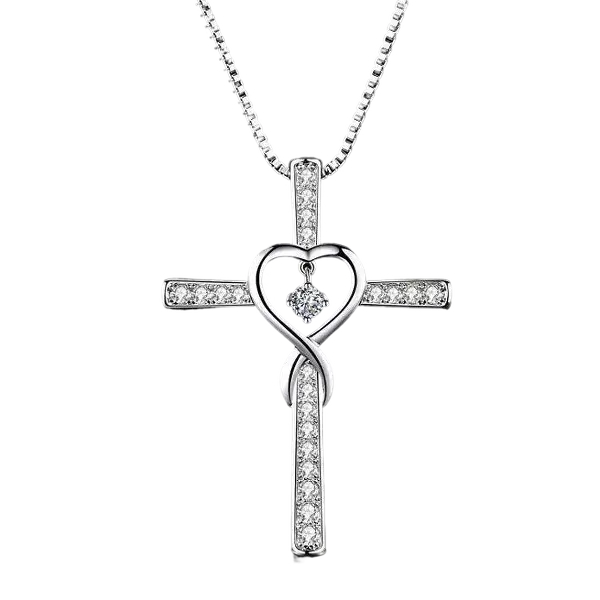
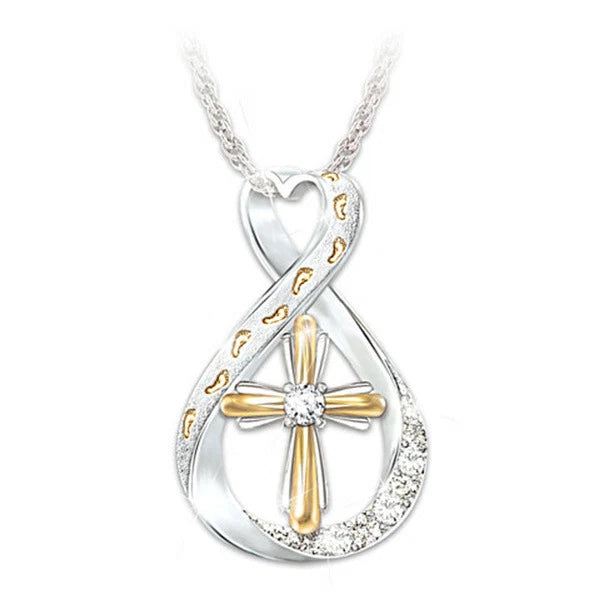
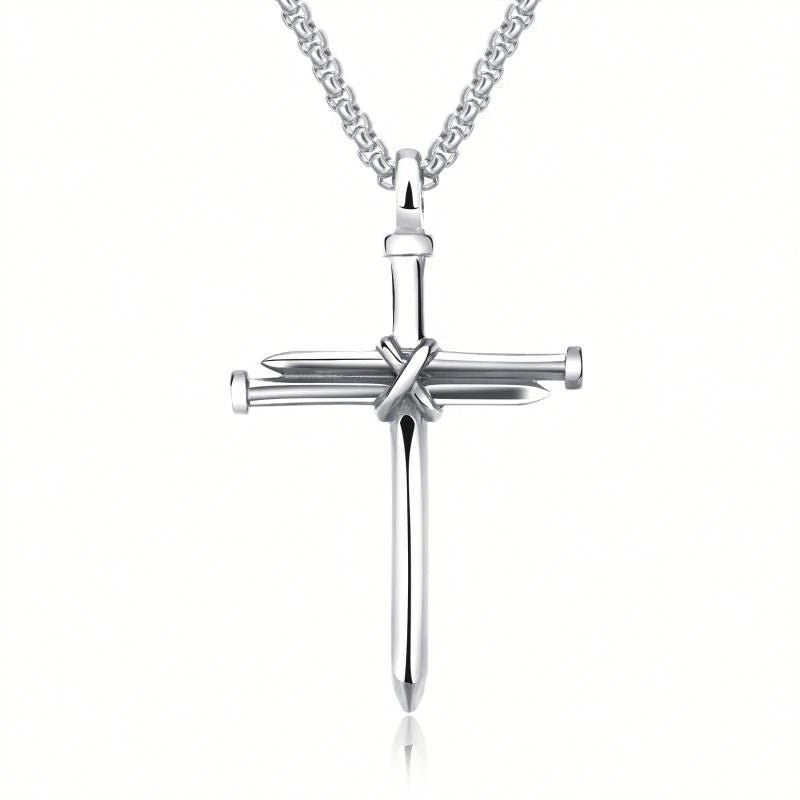
The cross is two lines crossing at a point the simplest mark a human hand can make and it is also the single most recognized symbol on Earth. It existed for thousands of years before Christianity gave it its most famous meaning, it has been carved into stone-age caves, worn by Egyptian pharaohs, painted on Roman shields, and hung around the necks of soldiers, mothers, grieving children, and skeptics who couldn't tell you why they still reach for it. This is the complete story: where it came from, what it has meant to different people across history, what happens to a symbol like this when nobody's watching, and why after everything it's still one of the first things a person puts on in the morning.
Where the Cross Came From Long Before Christianity
The cross is older than any single religion that uses it today. According to the New World Encyclopedia, cross-shaped marks appear in cult caves across Europe dating back to the Stone Age among the oldest deliberate symbols human beings ever made, long before writing existed. Nobody knows who drew the first one, or exactly why; the shape is simply the most basic possible intersection, which may be part of why it shows up independently, again and again, in cultures that never had contact with each other.

By the time recorded history begins, the cross is already everywhere. In ancient Egypt, the ankh, a cross topped with a loop, represented life and immortality, and appeared constantly in the hands of gods and pharaohs as a symbol of their power to give or protect life. In ancient India, a cross-shaped symbol represented Agni, the god of fire and light, and was built into altars and ritual sites. In Babylon and Persia, cross shapes appeared in religious art and inscriptions representing the connection between heaven and earth. Some historical sources trace one specific pre-Christian cross form to ancient Chaldea, associated with the god Tammuz. In pre-Christian Rome, the cross had already made its way into everyday religious life; the Vestal Virgins, Rome's sacred priestesses, wore a cross suspended from a necklace, centuries before any Christian did the same.
Even the swastika, a cross with bent arms, began as one of humanity's most widespread sacred symbols, representing the sun, sacred fire, or the four directions across cultures as distant from each other as India, Greece, and the ancient Americas, according to the New World Encyclopedia. Its meaning was catastrophically corrupted in the 20th century by a single political movement, but for nearly all of human history before that, it was simply another version of the same universal shape, understood as a mark of life and cosmic order.
Why the Cross Became a Symbol of Death
The cross's most painful chapter came from Rome, not from religion. Crucifixion was a Roman method of execution, deliberately designed to be slow and public a warning display, not a quick death. It was reserved largely for slaves, foreign rebels, and the lowest-status criminals, precisely because it was considered too degrading a death for a Roman citizen. This is the specific cross Jesus of Nazareth was executed on, in Roman-occupied Judea, sometime around 30-33 AD a detail confirmed independently by Roman and Jewish historical sources, not just Christian ones, making the crucifixion itself one of the best-attested events of the ancient world regardless of one's beliefs about its religious meaning.
Why Early Christians Didn't Actually Wear the Cross
Here's a detail almost never mentioned: the earliest Christians did not use the cross as their symbol at all. For roughly the first three centuries after Jesus's death, Christian art and identification relied on other images entirely of a fish, an anchor, a dove, a shepherd carrying a lamb. According to the Encyclopedia Britannica, it wasn't until the time of Constantine, in the 4th century, that the cross came into prevalent, public use as Christianity's symbol. Before that, using an execution device as your movement's public logo would have seemed less like faith and more like inviting the same fate; the symbol simply wasn't safe or appealing to display yet.
The Turning Point: Constantine and the Vision of the Cross
The moment everything changed, traces to a single Roman battle. On October 28, 312 AD, the Roman general Constantine faced his rival Maxentius at the Battle of the Milvian Bridge, just outside Rome, for control of the empire. According to ancient accounts primarily from the writers Lactantius and Eusebius of Caesarea, whose versions differ on the exact details Constantine reported a vision the night before the battle: a cross of light in the sky, accompanied by the words "in this sign, conquer." He ordered his soldiers to mark their shields accordingly (most historical sources specify the Chi-Rho monogram, the first two Greek letters of "Christ," rather than a literal cross shape) and won a decisive victory.
Whatever actually happened that night and modern historians openly debate how much of the account is legend built up after the fact the political result is not in question. Constantine credited his victory to the Christian God, legalized Christianity the following year through the Edict of Milan, and became history's first Christian Roman emperor. Within a generation, the cross went from a shape nobody wanted to be caught displaying to the public emblem of the most powerful empire on Earth. A three-century-old execution device became, almost overnight, a symbol of victory.
What the Cross Means in Christian Belief
In Christian theology, the cross represents two connected ideas that only work together: the crucifixion Jesus's death, understood as a sacrifice for human sin and the resurrection three days later, understood as proof that death did not have the final word. The apostle Paul wrote directly about this paradox in 1 Corinthians 1:18: the message of the cross seems like foolishness to those who don't accept it, but to believers, it represents God's power. Galatians 6:14 goes further, with Paul writing that he would boast in nothing except the cross of Christ. Colossians 2:14 describes sin itself as having been "nailed to the cross" canceled, not merely forgiven.
None of this theology requires the physical object of jewelry to be true; the belief exists independently of whether anyone wears a pendant. But for two thousand years, believers have chosen to wear the shape anyway, as a compact, physical reminder of an idea too large to hold onto by memory alone.
Why Nearly Every Human Culture Independently Reached for the Same Shape
Step back from any one religion, and a strange pattern emerges: human beings, completely unconnected across time and geography, keep independently landing on the same simple crossed-line shape to represent something sacred. Stone-age Europeans, ancient Egyptians, Vedic Indians, Babylonians, and pre-Columbian American cultures all did this without contact with one another. Psychologists have a name for why: humans are, in the words of researchers studying cultural symbolism, fundamentally "meaning-making creatures" who compress complex emotions, memories, and beliefs into something small and tangible precisely because carrying the full idea in words all day isn't practical. A wedding ring works the same way plain metal that means nothing to a stranger and everything to the person wearing it.
Carl Jung's concept of the archetype adds another layer: some images, Jung argued, emerge from something close to a shared human subconscious, which is one explanation for why totally disconnected ancient cultures kept independently creating crosses, suns, and circles as sacred marks rather than something more arbitrary. The cross may have endured for so many thousands of years, across so many unrelated civilizations, simply because the human mind is unusually drawn to marking the meeting point of two lines as significant a crossroads, literally and symbolically, of two paths meeting.
What Wearing One Actually Represents For Anyone, Not Just Believers
This is where history stops being just history and starts being personal. Research on symbolic objects consistently finds that the meaning of a worn symbol doesn't have to be shared or universal to be powerful for the individual wearing it. What matters is the story behind it, which is exactly why two people can wear an identical cross for entirely different reasons and both be completely sincere. For a believer, it's a direct statement of faith. For someone who isn't religious at all, it can just as genuinely represent a grandmother who wore one first, a hard year surviving, a hope held onto without a name for it yet, or simply an object that has quietly become part of how they recognize themselves in the mirror.
That's not a lesser use of the symbol, it's the same mechanism working exactly as it always has. Long before anyone attached a specific doctrine to it, the cross was already doing what every enduring symbol does: giving people a small, physical anchor for something too big to say out loud.
What Happens When You Don't Wear One
Nothing happens to the symbol itself; a cross left in a drawer doesn't lose its history, and Christian teaching does not treat wearing one as a requirement of faith at all. But something does tend to happen to the person, according to what people who've stopped and later restarted wearing one consistently describe: the specific, physical reminder disappears. Belief, memory, and hope don't need an object to exist but for most people, they're easier to hold onto with one than without. That's arguably the entire reason this particular shape has survived every collapsed empire, every changed religion, and every generation for the last several thousand years: not because anyone was ever forced to wear it, but because enough people, in enough different eras and belief systems, independently decided that carrying the reminder was worth more than leaving it behind.
Frequently Asked Questions
Did Christianity invent the cross symbol?
No. Cross-shaped symbols appear in Stone Age cave art and across ancient Egyptian, Indian, Babylonian, and Roman cultures long before Christianity existed. Christianity adopted and reinterpreted an already-ancient shape rather than creating it.
When did Christians start wearing the cross?
Not until the 4th century. For roughly the first 300 years after Jesus's death, early Christians used other symbols (a fish, an anchor, a dove) instead the cross only became Christianity's public symbol after Emperor Constantine's conversion in 312 AD.
What does the cross mean in the Bible?
The cross represents Jesus's crucifixion and, through His resurrection, the belief that death was defeated rather than final. Paul's letters describe it as the center of Christian belief (1 Corinthians 1:18) and as the place where sin itself was dealt with (Colossians 2:14).
Do you have to be religious for a cross to mean something to you?
No. Research on symbolic objects shows that personal meaning doesn't require shared or religious meaning to be genuine a cross can represent a specific person, a hard season survived, or simply an identity someone has built around it, independent of formal belief.
Why has the cross lasted this long across so many unrelated cultures?
Likely because it's both the simplest possible symbol a person can make and one of the oldest appearing independently across civilizations with no contact with each other, suggesting something in how humans naturally mark meaning rather than one culture's invention spreading everywhere.
Curious about the specific Christian meaning behind the cross necklace, and the different reasons people choose to wear one today? Read What Does a Cross Necklace Mean? Ready to find your own? Browse our cross necklace collection.

 FREE SHIPPING ALL OVER USA