The cross does not give you strength on its own. According to the Bible, strength comes from Christ, "through him who strengthens me," as Paul writes in Philippians 4:13, and it's specifically described as showing up in weakness rather than replacing it: "my power is made perfect in weakness," in 2 Corinthians 12:9. That's the theological answer, and it's more precise than most explanations of this topic. There's also a separate, physical answer. When someone holds, touches, or pictures a cross during a hard moment, controlled psychological research shows something measurable happens in the body, a real reduction in anxiety, independent of theology entirely. Both answers matter, and both are explained fully below, based on the original Greek text of the New Testament, the history of Christian theology, and published research on ritual and stress.
What the Bible Says About the Cross and Strength
Philippians 4:13 is the verse most connected to this question, and it's also the most commonly misread. Paul wrote it from a Roman prison, immediately after saying he had "learned the secret of being content in any and every situation, whether well fed or hungry, whether living in plenty or in want." The strength in verse 13 is specifically the strength to remain steady in both scarcity and abundance. It isn't a promise of success in whatever a person sets out to do.
The original Greek shows this precisely. Paul uses two different words for strength in one sentence: ischyō, "I have strength" or "I am able," and endynamounti, "the one continually strengthening me." The second word shares its root with dynamis, the Greek word for power that later gives English the word "dynamite." Paul isn't describing strength he already has stored up. The grammar describes an ongoing action, strength actively being supplied to him at the moment he needs it, not stockpiled in advance of hardship.
Other passages reinforce the same pattern. Ephesians 6:10 tells believers to "be strong in the Lord and in his mighty power," using the Greek words kratos and ischys, both describing power that belongs to God and is drawn on, not power a person generates independently. Colossians 1:11 and 2 Timothy 1:7 use similar language, describing strength as something given by God's Spirit for endurance, rather than a personal trait to cultivate on your own.
What Does "Power Is Made Perfect in Weakness" Mean? (2 Corinthians 12:9)
This verse is the actual mechanism behind the whole question, and it deserves more attention than it usually gets. Paul had asked God three times to remove a suffering he calls "a thorn in the flesh." The answer he records is: "My grace is sufficient for you, for my power is made perfect in weakness."
The Greek word for weakness, astheneia, comes from a root, sthenos, that originally meant "to hold together" or "stand firm." Biblical scholars have noted that this flips how the verse is usually read: to be "strong" in this word family means being able to hold your circumstances together, and astheneia describes the specific moment that grip fails, when things come apart faster than a person can manage. Paul isn't saying God's power appears despite a vague sense of frailty. He's saying it appears specifically at the point of collapse, not after the collapse has been resolved.
That's why Paul says he would rather boast about his weaknesses than have them removed. Removing the weakness, according to this verse, would also remove the specific condition under which this kind of strength is described as operating. This is also why the cross itself functions as the ultimate example in Paul's theology: it was, to every observer on the day it happened, a public demonstration of total defeat, and Christian teaching holds that God's power was most fully revealed exactly there.
Why Christ's Own Strength Came Through Emptying Himself
Before Paul ever writes about his own weakness, he describes Christ's. Philippians 2:6-8 says that Christ, "being in very nature God," did not cling to that status but "emptied himself," taking on human weakness, obedience, and death on a cross. The Greek word behind "emptied," ekenōsen, gives theology the term kenosis, self-emptying. This isn't a side note. It's the pattern Paul later applies to himself in Philippians 4:13 and 2 Corinthians 12:9: Christ's own strength on the cross was displayed precisely through voluntary weakness and obedience, not around it. The strength believers are told to draw on is modeled on the same shape.
Martin Luther's Theology of the Cross
This pattern became formal Christian doctrine in 1518, when the reformer Martin Luther presented what he called the theologia crucis, the theology of the cross, at a debate in Heidelberg. Luther argued there are two ways people try to find God. A "theologian of glory" looks for God in visible success, strength, and answers prayers that go the way a person hoped. A "theologian of the cross" looks for God specifically inside suffering, weakness, and circumstances that look like failure from the outside.
Luther's reasoning was that God had already shown his hand at the crucifixion, choosing to reveal power through what looked, to everyone present, like the worst possible outcome, the same kenosis Paul describes in Philippians 2. If that's where God chose to be found once, Luther argued, that pattern doesn't change. This is the theological explanation for something many Christians report anecdotally: faith that feels strongest during the hardest season of a person's life, not despite the difficulty, but running directly through it.
What Does It Mean to "Take Up Your Cross"?
Separate from the crucifixion as a completed, historical event, Jesus used cross-bearing as an instruction for his followers: "Whoever wants to be my disciple must deny themselves and take up their cross and follow me" (Matthew 16:24). Everyone listening understood the reference immediately. Rome forced condemned prisoners to carry the crossbeam of their own execution through public streets. This was not a metaphor about minor inconvenience.
Over the centuries, the phrase came to mean carrying a specific, ongoing hardship, an illness, a difficult relationship, a hard financial season, for the sake of staying faithful, not because the hardship feels good or resolves quickly. This is a different claim than the strength described in Philippians 4:13 or 2 Corinthians 12:9. It doesn't promise the weight will get lighter. It describes a form of endurance and meaning available while carrying it, which is a distinct kind of strength from the two verses covered above.
Does Wearing a Cross Necklace Actually Give You Strength?
This is where the question moves from theology into measurable psychology. Researchers at Harvard Business School have studied what happens when people perform a small, repeated, symbolic action, a ritual, during a hard moment, whether or not the ritual is religious. In one set of published studies, people who performed a brief ritual after a painful loss reported measurably less grief than people who didn't, and the effect held even among participants who said outright that they didn't believe the ritual would do anything. In a separate set of experiments on performance-related anxiety, before public speaking, people who performed a short ritual beforehand showed lower measured anxiety and performed better than those who skipped it.
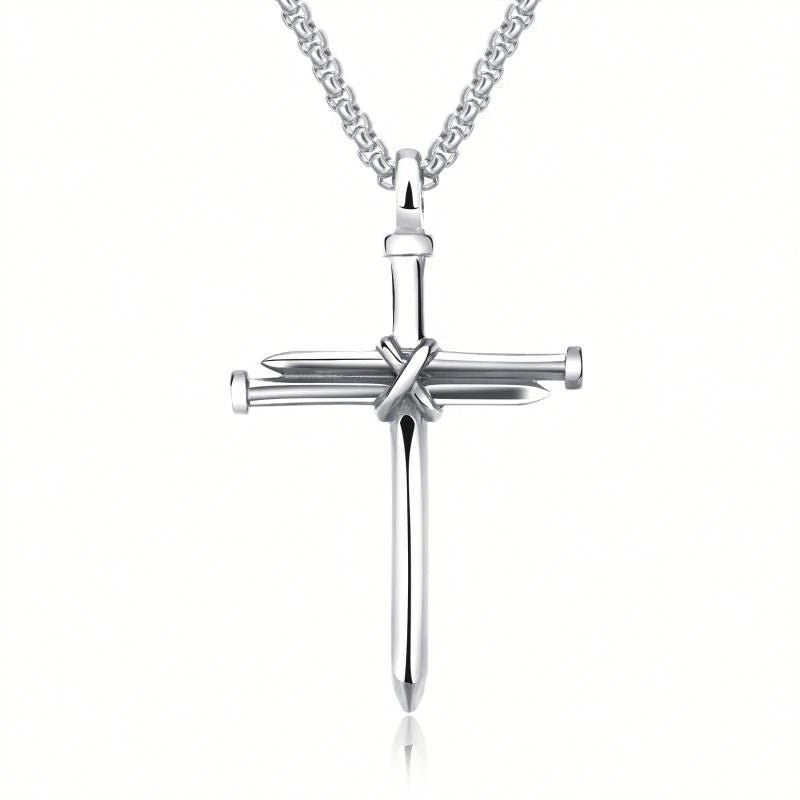
The mechanism the researchers identified wasn't belief. It was controlled. A repeated physical action gives a person back a felt sense of agency in a situation where they otherwise have none. Making the sign of the cross, holding a cross necklace during a hard conversation, or picturing one before a difficult moment fits this exact description. This is a genuine reason people find themselves reaching for a cross necklace specifically during stress, and there's a documented, measurable effect behind it, separate from whatever a person's theology says about the object itself.
Historical Examples of People Who Found Strength in the Cross
This pattern shows up in documented history, not only in devotional writing. During the Cristero War in Mexico between 1926 and 1929, Catholics executed by the government for practicing their faith were widely reported to have died saying "¡Viva Cristo Rey!", Long live Christ the King, a direct appeal to the same crucified and risen Christ described in Paul's letters. Corrie ten Boom, imprisoned in the Ravensbrück concentration camp during the Second World War for hiding Jewish refugees, wrote after her release about relying on her faith to survive conditions built specifically to remove every ordinary source of human dignity. The German pastor Dietrich Bonhoeffer, executed in 1945 for resisting the Nazi regime, built much of his theology around the same idea, that authentic faith doesn't avoid suffering but is sustained through the middle of it.
These examples line up with the pattern described in the Greek text centuries earlier: strength located specifically inside collapse, not delivered as an escape from it.
Do All Christian Traditions Agree on This?

Every mainstream Christian tradition agrees the object itself has no independent power, but they describe where the strength comes from somewhat differently. Catholic teaching often connects it to grace received through the sacraments, and to the belief that personal suffering can be spiritually united to Christ's own. Orthodox Christians express the same idea liturgically, through the sign of the cross made as an act invoking God's authority, not a gesture with power of its own. Most Protestant and evangelical traditions describe it more simply, as grace received through faith, with the cross functioning as a reminder rather than a channel. A small number of groups, including Jehovah's Witnesses, reject the cross shape entirely, arguing it wasn't the actual method of execution, while still crediting strength to God's spirit directly. The disagreement across these traditions is about mechanism, not about whether an object can generate power on its own. On that point, they agree.
Anyone weighing the difference between a plain cross and a crucifix in this context may find this breakdown of the two symbols useful, since Catholic and Orthodox tradition tend to favor the crucifix specifically because it depicts the suffering this article has been describing.
The Bottom Line
Yes, but through two separate, real mechanisms that are rarely explained together. Theologically, the New Testament describes strength as something continuously supplied by Christ, arriving specifically at the point a person's own strength has run out, a pattern Martin Luther later built into a formal theology centered on God's power being revealed through weakness rather than around it. Separately, and independent of theology, published research on ritual behavior shows that a small, repeated, symbolic action, like touching or holding a cross, measurably reduces anxiety and restores a person's sense of control, a benefit that shows up even in people who don't consciously believe the action is doing anything.
Neither explanation replaces the other. For a believer, they describe the same experience from two directions: one explains where the strength ultimately comes from, and the other explains why a small, physical habit helps a person keep returning to that source in the exact moment it's needed. Anyone wanting the fuller history behind why this symbol carries this much weight can find it in this look at where the cross came from and what it has meant across the centuries.
Frequently Asked Questions
What does it mean when people say the cross gives you strength?
It means strength is credited to Christ, not the physical object. Philippians 4:13 and 2 Corinthians 12:9 both describe strength as something supplied by Christ specifically at the point a person's own capacity runs out, with the cross representing the clearest example of that pattern in Christian theology.
What does Philippians 4:13 actually mean?
Paul wrote "I can do all things through Christ who strengthens me" after describing his ability to be content whether he had plenty or nothing. It's a statement about enduring hardship and scarcity, not a promise that a person can achieve any goal they set for themselves.
What does "my power is made perfect in weakness" mean?
It's from 2 Corinthians 12:9, where God tells Paul that divine strength reaches its fullest expression at the point of human weakness, not once the weakness is resolved. The Greek word for weakness describes the specific moment a person can no longer hold their circumstances together.
Does wearing a cross necklace actually make you feel stronger?
Yes, through a documented psychological mechanism. Published research on ritual behavior shows that a repeated, symbolic action like touching a cross measurably lowers anxiety and restores a person's sense of control, an effect that holds even for people who aren't consciously thinking about their faith in that moment.
What does it mean to "carry your cross"?
It comes from Matthew 16:24, where Jesus described ongoing faithfulness through a real, personal hardship rather than escape from it. Unlike Philippians 4:13, it doesn't promise the difficulty will get lighter; it describes finding meaning and endurance while carrying it.
Can someone who isn't religious feel strength from a cross?
Yes, to a degree. Research on ritual behavior shows that symbolic, repeated actions can reduce measured anxiety and restore a sense of control regardless of belief. The specific theological strength described in Scripture, however, is tied to faith in Christ rather than the action alone.
What is kenosis and how does it relate to this?
Kenosis comes from the Greek ekenōsen, "emptied," in Philippians 2:6-8, describing how Christ set aside his status to take on human weakness, obedience, and death on a cross. It's the theological pattern behind the whole question: Christ's own strength was displayed through voluntary weakness, which is the same shape Paul later describes for believers in Philippians 4:13.
Do all Christians believe the cross provides strength in the same way?
No. Catholic and Orthodox traditions often connect it to grace received through the sacraments or liturgical practice, most Protestant traditions to grace received through faith alone, and a small number of groups reject the cross symbol entirely while still crediting strength to God directly.

 FREE SHIPPING ALL OVER USA