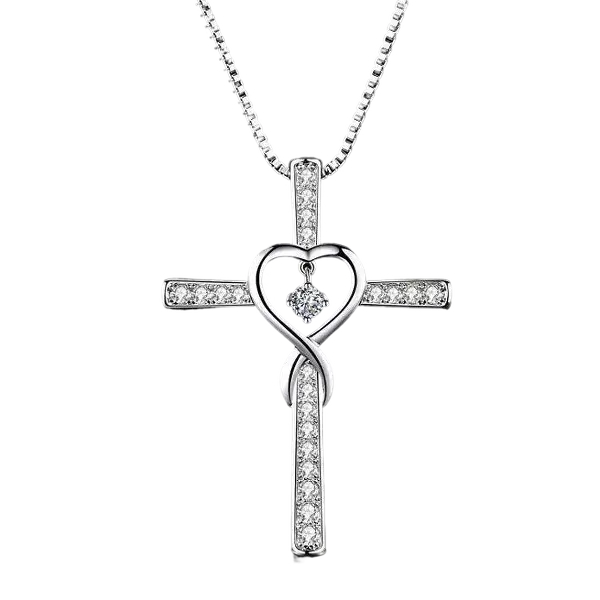
Beyond its Christian origin, the cross symbolizes strength and resilience (the root of the phrase "bearing your cross"), family heritage and cultural identity, individuality and quiet rebellion, personal style, and for many non-religious wearers a sense of hope or protection tied to a specific memory or person rather than a specific doctrine. None of these meanings replace the cross's religious foundation; they sit alongside it, which is exactly why the same shape can mean something different to the person standing next to you.
If you've ever wondered whether it's "allowed" for a cross necklace to mean something else to you personally, something not about church attendance, the direct answer is yes. The cross has carried extra-religious meaning for as long as it's been worn, and understanding those layers helps you wear it (or gift it) with more intention, not less. This isn't a workaround or a loophole; it's simply how symbols this old actually function. A shape that's been in continuous use for two thousand years accumulates meaning the way a well-worn object accumulates fingerprints the original purpose stays intact, but it's no longer the only thing the object carries.
Strength and Resilience: "Bearing Your Cross"
The phrase "bearing your cross" is now used almost entirely as a secular idiom for enduring a hard personal burden, even though it originates directly from the Bible. Jesus used the phrase in Luke 9:23 and Luke 14:27, instructing His followers to "take up" or "carry" their cross daily as a condition of discipleship language rooted in the literal practice of condemned prisoners carrying their own execution beam. Over centuries, everyday usage drifted from that specific, demanding meaning toward something much broader: any ongoing hardship a person quietly endures, from a difficult family situation to a chronic illness. Biblical commentators are often careful to point out that this popular usage isn't quite what Jesus meant; the original phrase was about surrender and discipleship, not hardship in general but the drift happened anyway, the way idioms usually do, and it's the version most people actually encounter today. For someone who reaches for a cross necklace during a hard season, "strength to bear what I'm carrying" is frequently the meaning in mind, whether or not they'd trace it back to Luke 9:23 themselves. That's not a misuse of the symbol so much as a natural extension of it the necklace becomes a small, physical checkpoint a person can return to during a long stretch of difficulty, in much the same way people repeat a mantra or carry a specific photo. The theology and the everyday coping mechanism aren't actually in conflict; the second grew out of the first, even if most people using the phrase today have never opened a Bible to check.
Family Heritage and Cultural Identity
For many wearers, a cross necklace is inherited meaning as much as chosen meaning it comes from a family or culture, not just a belief. In many Latino households, a cross is a constant, everyday presence worn, hung in the car, displayed at home tied as much to family and cultural continuity as to individual religious observance. Among people of Irish and Scottish descent, the Celtic cross its distinctive ring, whose exact origin historians still debate (theories range from a pre-Christian sun symbol to a purely structural support for the stone cross arms) is worn as a dual statement of faith and ethnic heritage, and it's commonly chosen by descendants who want to honor that ancestry even if they don't personally attend church. In Eastern European and Orthodox Christian communities Russia, Greece, Serbia, and others a baptismal cross is often given in infancy and worn for life, making it less a personal fashion choice than a marker of family lineage and community belonging carried from birth. Across all three of these traditions, the meaning isn't really "I believe this theology" it's closer to "this is where I come from." That distinction matters practically, too: someone shopping for a Celtic cross to honor Irish ancestry and someone shopping for one purely for its knotwork design are often drawn to the exact same piece from two different directions, and jewelers who understand that tend to describe designs by their heritage story rather than assuming every buyer wants a theology lesson.
Individuality and Quiet Rebellion
In gothic, punk, and broader alternative subcultures, a cross is frequently worn as an identity marker for the community itself rather than as a statement about Christianity one way or the other. The pattern traces back to the genre's post-punk origins in late-1970s England, where bands like Bauhaus and Siouxsie and the Banshees folded religious imagery into their visual identity rather than avoiding it, pairing crosses with themes of mortality and beauty rather than doctrine. A parallel, unrelated chain of reappropriation happened with the Iron Cross specifically: originally a medieval Teutonic Knights emblem from around 1190, it became a Prussian military decoration in 1813, was brought home by American servicemen as a WWII souvenir, and eventually landed on outlaw motorcycle club vests by the 1960s as a badge of defiance a completely different symbolic path from the goth cross, arriving at a similar place: individuality expressed through a borrowed religious shape. In both cases, wearing the symbol isn't usually read within the subculture as mockery of Christianity; it's read as belonging to a specific visual language that happens to include the cross.
Personal Style and Minimalist Fashion
Increasingly, a cross necklace is chosen the same way any other pendant shape would be: because the wearer likes how it looks, not because of what it represents. In a 2025 Washington Post feature interviewing cross-wearers of all ages and backgrounds, several described the symbol in almost identical terms a piece of jewelry they find genuinely attractive and versatile, distinct from any specific belief they hold. A high schooler quoted in the piece put it plainly: it's jewelry, it's cute, and she knows what it personally means to her, regardless of not identifying with organized religion. This is one of the fastest-growing reasons for wearing a cross today, driven partly by minimalist jewelry trends where a simple cross reads as clean and versatile rather than overtly symbolic but it coexists with, rather than replaces, every other reason on this list, often in the same person over time.
Hope, Protection, and Remembrance Without Doctrine
Even wearers who don't identify with Christianity often describe a cross necklace in terms of hope, protection, or connection to a specific person, without attaching it to any doctrine. In the same Washington Post feature, one interviewee, a 68-year-old home improvement professional who never takes off his father's cross, separately recalled a related childhood memory: his mother had him wear a St. Christopher necklace, a Christian symbol associated with protecting travelers, specifically so it would watch over him on trips. Neither memory was framed by him as a statement of doctrine; both were framed as protection tied to a specific person he trusted. This kind of meaning is common: the necklace becomes attached to a specific person, a specific worry, or a specific hope, and the symbol's job is less about theology and more about carrying that association with you.
What the Cross Can Symbolize, at a Glance
| Symbolic Meaning |
Where It Shows Up |
Typical Wearer |
| Strength / resilience |
The idiom "bearing your cross," worn during hard seasons |
Anyone enduring an ongoing personal struggle |
| Heritage / cultural identity |
Celtic cross, Orthodox baptismal cross, everyday Latino household presence |
Multigenerational families, specific cultural communities |
| Individuality / quiet rebellion |
Goth, punk, and biker subculture jewelry |
Members of alternative subcultures |
| Personal style |
Minimalist layered jewelry, everyday fashion |
Fashion-forward wearers of any background |
| Hope / protection / remembrance |
Given by a parent, tied to a specific person or worry |
Wearers with a personal story behind the piece |
| Religious faith |
Traditional Christian practice |
Practicing Christians of any denomination |
This secular-meaning question has even reached the U.S. Supreme Court. In its 2019 ruling on a decades-old war memorial cross in Bladensburg, Maryland, the Court found that a cross can, in certain public contexts, carry a meaning other than a strictly religious one. Justice Samuel Alito wrote in the majority opinion that while the cross became Christianity's central symbol by the fourth century, it has also taken on a genuinely secular meaning in specific contexts. The ruling itself was legally contested; some legal scholars argued it inappropriately stretched the definition of "secular" but the underlying observation lines up with what jewelers and researchers see anecdotally every day: the same shape can carry more than one kind of meaning depending on who's looking at it and why.
Does Wearing It for Style Diminish Its Meaning for Others?
No one person's reason for wearing a cross doesn't subtract from what it means to someone else who wears the same shape for religious reasons. Meaning isn't a fixed, shared resource that gets diluted when more people use a symbol; it's assigned individually, which is why the same necklace can be a quiet declaration of faith on one wearer and a family heirloom, a fashion choice, or a source of personal strength on another, simultaneously and without contradiction. That said, wearing any religious symbol with a little awareness knowing that it does carry a specific, meaningful history for millions of people tends to go a long way, even for someone who has chosen it for entirely personal reasons.
Why These Meanings Usually Overlap, Not Compete
In practice, almost nobody's cross necklace carries exactly one of these six meanings. A woman might wear a Celtic cross that was her grandmother's (heritage), reach for it specifically during a hard week at work (strength), and also just genuinely like how it looks with everything else in her jewelry box (style) all from the same pendant, all at once. A goth teenager's cross might start as a subculture identity marker and, years later, quietly become the object they touch during a panic attack, without either meaning canceling the other out. This layering is the norm, not the exception, and it's part of why a question like "what does the cross symbolize beyond religion" doesn't have a single tidy answer the honest answer is closer to a short list, with most wearers checking more than one box without ever having to choose just one.
Frequently Asked Questions
Can a cross mean strength instead of religion?
Yes. The popular phrase "bearing your cross" has become a widely used, largely secular way to describe enduring a difficult personal burden, and many wearers choose a cross specifically as a reminder of that resilience.
Why do non-religious people still find the cross meaningful?
Because meaning attaches to more than doctrine a cross can represent family heritage, a specific person, a personal milestone, or simply an aesthetic the wearer is drawn to, all independent of religious belief.
Is "bearing your cross" a Biblical phrase or just an expression?
Both. It originates directly from Jesus's words in Luke 9:23 and Luke 14:27, but its everyday use today describing any ongoing personal hardship has drifted from that original, more specific meaning about discipleship and surrender.
Does wearing a cross for its look diminish its meaning for others?
No. Personal meaning isn't a shared, limited resource; one wearer's aesthetic choice doesn't reduce or change what the same symbol represents to a wearer using it as a religious statement.
Want the full religious and historical meaning behind the symbol? Read What Does a Cross Necklace Mean? Meaning, History & Why People Wear One Curious about the psychology and everyday motivations behind wearing one? See Why Do People Wear a Cross Necklace? 6 Real Reasons Explained Choosing your own piece? Our buying guide to metal, sizing, and how to verify what you're getting covers exactly what to look for. Ready to browse? See our cross necklace collection.

 FREE SHIPPING ALL OVER USA