A nail cross necklace symbolizes the sacrifice, suffering, and ultimate triumph of Jesus Christ, with the nails standing in for the ones used at the crucifixion. Most wearers see it as carrying three ideas at once: pain that was willingly endured, redemption that followed it, and a personal reminder to keep that story close. But the symbol holds more than one sentence can capture. Its meaning shifts slightly depending on how many nails are used, what the piece is made from, and even which century you're looking at.
This guide covers all of it: the biblical basis, the real history behind the design, the debate over three nails versus four, and why this particular piece has become one of the most requested styles in faith jewelry.
What Is a Nail Cross Necklace, Exactly?
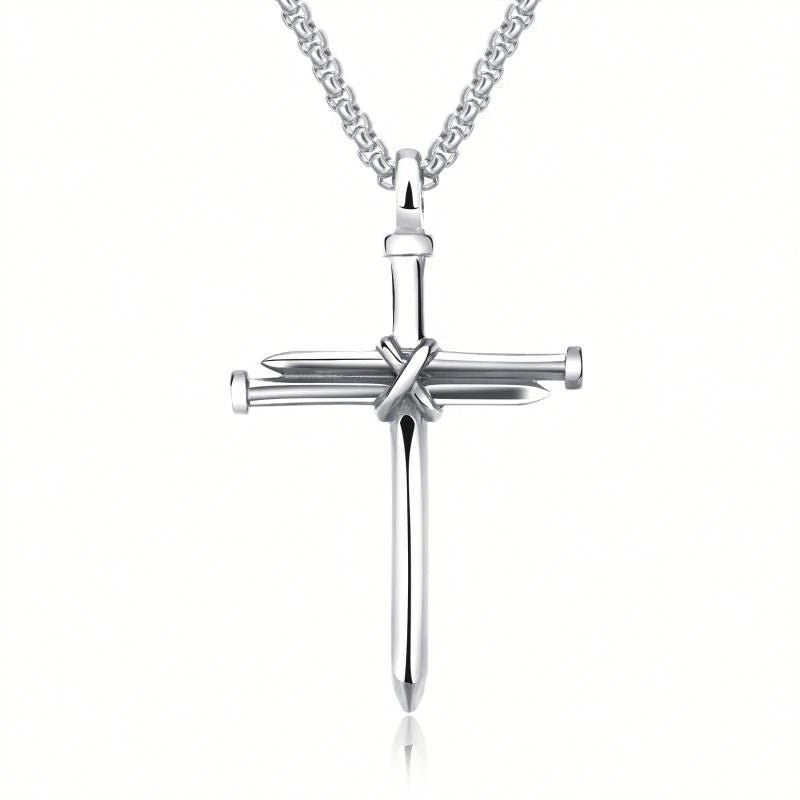
A nail cross necklace is a pendant shaped like a cross, but instead of being cast as one smooth piece of metal, it's built from individual nail shapes, usually two, three, or four, bound or welded together. Some versions use realistic, hand-forged nails. Others use a sleeker, modern silhouette that only hints at the shape. Either way, the goal is the same: to bring the crucifixion itself into the design, not just the cross that resulted from it.
It helps to be clear about what a nail cross is not. It isn't a crucifix, which includes a figure of Christ's body on the cross. A nail cross stays abstract, nails only, no figure, and that's part of its appeal for people who want something symbolic without it feeling overly literal. A nail cross sits in the middle: more direct than a plain cross, less literal than a crucifix.
The Core Symbolism: Sacrifice, Redemption, and Victory
Sacrifice
At its center, the nail cross points straight at the crucifixion. In John's Gospel, after the resurrection, the disciple Thomas says he won't believe unless he sees "the mark of the nails" in Christ's hands (John 20:25), one of the clearest direct references in scripture to nails being used. Wearing a nail cross is, in a small way, wearing that detail. It's a reminder that the suffering described in the Gospels wasn't abstract. It was physical, specific, and nailed to wood.
Redemption
There's a second, more hopeful layer underneath the first. Colossians 2:14 describes a record of sin being canceled and nailed to the cross along with it. Read this way, the nails stop being only about pain and start being about a debt that got settled. The instrument of suffering becomes, in the same verse, the thing that seals a promise.
Victory
Many wearers point to John 19:30, where Jesus's final word from the cross, Tetelestai, "It is finished," is read as a declaration of completed work rather than defeat. You'll actually see that phrase engraved on some nail cross designs for exactly this reason. Seen this way, the nails aren't only a symbol of suffering. They mark something that was finished on purpose, which is why so many people describe the necklace as a reminder of victory rather than pain.
Where the Symbol Actually Comes From: A Short, Honest History
The Biblical and Historical Roots
Crucifixion by nailing was a documented Roman practice, though historians note the method varied and that ropes were sometimes used instead, depending on the era and the executioner. What we know with more confidence comes straight from scripture: Thomas's words in John 20:25, and Luke 24:39, where the resurrected Christ shows his hands and feet as proof of who he is. Early church writers, within the first few centuries after Christ, also wrote about nails specifically. That's a large part of why the detail became so central to Christian art, and eventually, to jewelry.
The Coventry Cross of Nails: A Lesser-Known but Real Chapter
There's a second, more modern history behind the nail cross that most people have never heard, and it has nothing to do with jewelry catalogs at all.
On the night of November 14, 1940, German bombers destroyed much of Coventry Cathedral in England during the Blitz. The next morning, among the wreckage, someone found large medieval roofing nails that had fallen with the collapsed beams. Rather than clear them away as debris, they were bound together into the shape of a cross. That first cross wasn't built to represent suffering alone. It was built to represent survival.
In 1947, two years after the war ended, that same design was given as a gift to a church in Kiel, Germany: a deliberate act of reconciliation between two nations that had recently been at war. Over the following decades, hundreds more crosses made from salvaged nails were given to churches, schools, and even prisons around the world. By the 1970s, the recipients had formed what's now known as the Community of the Cross of Nails, a network that today spans hundreds of organizations in more than 40 countries, all connected by the same object: a cross made of nails, given as a gesture of peace rather than grief.
This detail matters because it means the nail cross doesn't only look backward at the crucifixion. In this branch of its history, it points toward forgiveness between people in the present, and it's a large part of why so many wearers today describe the necklace as being about resilience as much as remembrance.
How Many Nails? The Debate Behind 3 vs. 4
Shop for a nail cross necklace for long enough and you'll notice that some designs use three nails and others use four. The difference isn't random.
The idea that Jesus was crucified with exactly three nails, one through each hand and one through both feet together, isn't stated outright in scripture. It became a popular tradition in Christian art partly because three nails made for a cleaner, more compact visual, and partly because the number carried extra meaning: many designers and wearers connect it to the Holy Trinity, Father, Son, and Holy Spirit, turning the nails into a stand-in for that core belief.
Four nails, one through each hand and each foot separately, is generally considered the more historically accurate depiction, and it became the standard in most later Catholic art and tradition. The three-nail interpretation was actually debated among early church figures for centuries before the four-nail version settled into place as the accepted norm by the medieval period.
Neither version is "wrong" for jewelry. They simply emphasize different things: a three-nail design leans into the Trinity connection, a four-nail design leans into historical realism, and most people end up choosing based on which meaning resonates rather than which one is technically correct.
Is There a Meaning Beyond Christianity? Folklore and Protection
Before nails carried this specific Christian meaning, iron itself already had a reputation in older European folk traditions as something that could ward off bad luck. That belief predates the Christian symbolism and runs parallel to it rather than replacing it, which is part of why nail imagery has always felt a little protective, even to people encountering it outside a religious context.
That raises a fair question for anyone unsure whether the symbolism is "real" in a literal sense, or whether its power is closer to a felt sense of comfort and identity. Either way, the nail cross sits at the intersection of formal religious meaning and older, more instinctive ideas about protection.
Different Styles of Nail Cross Necklaces (and What Each One Emphasizes)
Not every nail cross carries the exact same emphasis. Material and shape shift the meaning slightly:
| Style |
What It's Made From |
Primary Meaning |
| Classic nail cross |
Two, three, or four nail-shaped pieces bound into a cross |
Crucifixion, sacrifice, redemption |
| Horseshoe nail cross |
Nails shaped like actual horseshoe nails |
Faith combined with strength and protection, popular in equestrian and rural Christian communities |
| Railroad spike cross |
A single heavier spike, cross-shaped or worn as-is |
Endurance, a long journey, steady strength under pressure |
| Coventry-style cross of nails |
Three large nails bound with wire, echoing the original Coventry design |
Peace, reconciliation, survival after destruction |
| Celtic nail cross |
Nail cross combined with a Celtic knot or ring |
Faith paired with heritage and continuity |
Most buyers gravitate toward the classic version, but the variations are worth knowing about. The differences are subtle on the surface and genuinely meaningful to the people who choose them on purpose.
Who Wears a Nail Cross Necklace, and Why
The honest answer is a wide range of people, for a wide range of reasons.
For many Christians, it's a daily, tactile reminder of what they believe, closer to a habit than a statement piece. It gets touched during prayer, worn under a shirt where no one else can see it, or given at moments that mark a real step in someone's faith, like a baptism or confirmation.
For others, especially people moving through a hard season, the necklace becomes less about doctrine and more about comfort and strength: something physical to hold onto when words fall short. Whether the object itself is doing that work, or simply reflecting a strength someone already has, isn't a question that needs a single tidy answer.
Then there's a third group drawn to it for reasons that are only partly religious. The raw, slightly rugged look of forged nails has made its way into rock, punk, and biker style for decades now, worn by people who may not attend church regularly but still feel pulled toward what the symbol represents: something broken that became stronger for it.
Choosing a Nail Cross Necklace That Feels Right for You
A few practical things matter here alongside the symbolism, whether you're buying for yourself or as a gift.
Material. Stainless steel is the most common modern choice because it resists tarnishing and holds up to daily wear without much upkeep, an advantage if the piece is meant to be worn constantly rather than saved for special occasions.
Nail count. As covered above, three nails leans toward the Trinity association and four leans toward historical accuracy. Neither is more "correct." It's a matter of which meaning you want to carry.
Engraving. Some designs include a short verse reference, like John 19:30, which ties the piece back to the "it is finished" idea instead of leaving the symbolism unspoken.
Everyday wearability. A piece too delicate for daily wear tends to end up sitting in a drawer instead of being worn. Something built for everyday use holds up far better to actual life, worn under clothes, through an ordinary week, which matters if the whole point is for it to work as a constant, low-key reminder rather than an occasional accessory.
Whatever you land on, the meaning doesn't come from the price tag or the finish. It comes from what the wearer already believes before they put it on.
Frequently Asked Questions
What do the nails on a cross necklace actually represent?
They represent the nails used in Christ's crucifixion, standing in for sacrifice, redemption, and, depending on the wearer's interpretation, ultimate victory rather than defeat.
Is a nail cross necklace the same as a crucifix?
No. A crucifix includes a figure of Christ's body on the cross. A nail cross keeps the design abstract, made only from nail shapes, with no figure at all.
Why do some nail cross necklaces have three nails and others have four?
Three nails is often connected to the Holy Trinity and became a popular artistic tradition. Four nails is generally considered the more historically accurate depiction of the crucifixion. Both are common in jewelry design today.
What is the Coventry Cross of Nails?
It's a specific historical cross made from medieval nails salvaged after Coventry Cathedral was bombed in 1940. It was later given as a gift of reconciliation to a German church in 1947 and went on to inspire a global network of organizations built around that same idea of peace after destruction.
Can someone who isn't religious wear a nail cross necklace?
Yes. Its roots are explicitly Christian, but plenty of people wear it for what it represents more broadly: resilience, endurance, or simply an appreciation for the design, without that changing what it means to someone who wears it as an expression of faith. There's no rule about who is or isn't allowed to wear one.
The meaning behind a nail cross necklace isn't fixed. It shifts a little depending on who's wearing it and why. At its root, though, it stays the same: a small, unavoidable reminder that something painful can still end in something worth holding onto.

 FREE SHIPPING ALL OVER USA